Camerado! I give you my hand!

Camerado! I give you my hand!

Allons! The road is before us!

www.poochprofessor.com


Showing posts with label trees. Show all posts

Tuesday, June 21, 2022

Enduring the Erosion

The breeze slides off the lake, slips nimbly up and over the ragged, red clay bank, and swirls in eddies around my bare feet. It shimmies past the perspiring skin on my arms and legs just enough to keep me from retreating to the air-conditioned camper. The water is mostly still today, only occasionally ruffled by a pleasure boat. I am fully ensconced in the shade of several young white oak trees, trees whose leaves capture (but fail to hold) the edges of the breeze caressing us all.

Many thoughts have been breezily swirling in my brain since we arrived to this quiet cove yesterday, though I fully admit to pushing some of them away so that I might remain fully present. I don’t push them away because they are unpleasant or difficult (though some are); I simply, right now, want to focus on, well, a tree.

What has captured my pen today is one singular oak to my right, the same age as her sisters (I’m guessing 25-50 years old, which is, in oak years, practically newborn*). She is the victim of unfortunate circumstance, an event probably created by drought, likely in the last 3 years.

The earth simply could not hold her where she planted herself, on a promontory too close to the water’s edge, and erosion beneath took its toll eventually, causing her to now be tilted precariously towards the water at a 45 degree angle. Her branches are in full summer outleaf and her trunk remains stubbornly sturdy; the top edge of her root ball has feathered away, though, and the exposed roots show minimal, but concerning, damage.

I have no idea how long she will persevere in this this inalterable state, and I find myself wondering how she will cope with this predicament, how much further she will fall over time, and how much time she has left, knowing full well only two things: she will never ponder these thoughts, and now, I will never not ponder them.**

Perhaps she will compensate for being off-balance by sprouting new branches on her skyward side, strengthening the ones already there, or curving her trunk, to act as ballast.

Perhaps she will call out to her brethren and sound an alarm, and they will come to her aid, as trees do--sending nutrients through the mycelium to boost her and hold her steady against the wind and water and the ravages of time.

Perhaps she will be able to hold herself in this altered state for many years, and perhaps not. She has no idea how long the remaining dirt under her will last, and she may not be able to compensate being fully waterlogged at the base once it gives way.

And then there’s the question of what will happen if roots, trunk, and branches become partly or mostly permanently submerged. White oaks are hardy, sure, but they are not suited for under-the-waterline stasis like a bald cypress, swamp tupelo, or even a willow. She could live for years more--even if she slips below the waterline. But she will likely not thrive in that state and would certainly not reach full age and mass.

Her roots hold fast to the remaining bank for now, and she continues to hold fast to her white-oakness; what other choice does she have, really?

It makes me think about how we humans cope with change, how we adjust ourselves when things interrupt our growth and/or purposely or unconsciously try to drag us down.

The tree doesn’t need to “think on her feet.” She holds this new line as only she can: with blinding slowness and complete neutrality, with steady composure, without dread. It will take months, nay, years for her to make adjustments to trunk or branches, and they will be so incremental that they would hardly be noticed with the naked eye. The challenge she faces is not one where quick thinking matters; she will adjust, but with no haste.

Meanwhile, life/the Universe flings all manner of feces at us daily: we lose jobs, our spouses divorce us or we divorce them, partnerships dissolve, our beloved soul friends move away physically or drift away emotionally (the latter, of course, being even more painful), our pets face trauma and illness and we must face their mortality, and our loved ones face illness, adversity, and death. Our hearts break, capsizing upon themselves in white-hot agony, and we are stripped bare by the futility of circumstance. Our existence can be thrown into chaos with one phone call, one unnoticed red light, one instant of distraction, even one stumble off the curb. Change is the only permanence in our lives, and often, we are not ready to face it, let alone cope with it in healthy ways. It’s funny: humans have adjusted and adapted over centuries to all manner of newness and strangeness, and persevered. But we crave consistency and sameness, routine and ritual, nonetheless.

And there is nothing wrong with this craving. Wanting consistency, desiring ritual, and needing routine have helped us adapt, actually: stability is nothing to sneeze at. We are creatures of habit.

But the Universe doesn’t really care about that, does it? We know that Life Happens--and storybook endings rarely do. We know, intellectually, that bad things happen to good people and vice-versa, that adversity doesn’t discriminate, and that life is actually rarely fair. So that means we realize that change will come and it may often be unwelcome, but we must cope. What other choice do we have?

And, unlike this young tree facing adversity, we often need to adjust to change very quickly, even though what we’d really like is More Time to learn how to cope with the inevitable erosion of what we are used to. Our heads understand what is needed, but our vulnerable hearts are slow to catch up (and often too swift to declare they will never embrace vulnerability again). The tree, lacking a breakable heart, has nothing but time to adjust, but we are rarely afforded that luxury.


As we feel our feet being ripped from underneath us, find ourselves tipping toward the water as the earth sloughs away, we realize that we can change nothing about the circumstance but ourselves: we can compensate for being off-balance by sprouting new branches on our skyward surface, strengthening the ones already there, or curving our trunks, to act as ballast. We can reach out to our brethren for aid, and open ourselves/be receptive to the nutrients they provide us.

We can experience change (and the knowing that it will always be watching us from just outside our awareness, peeking through a crack in the curtains, waiting to pop over for a “quick chat” just when we have settled ourselves into a cozy  nap in the familiar) by activating the stalwartness we, like the tree, already possess.

The leaning tree cannot control the erosion, nor can she adapt quickly to adversity, change, or distressing situations. But she copes, regardless. And we learn, sometimes against our wishes, that we can cope, provide ourselves ballast, and thrive over time despite adversity, discomfort, and even heartbreaking pain.

What other choice do we have?

****************************************

*The common folklore is that oak trees grow for 100 years, live for 100, and die for 100.

**Will I think about this tree constantly? Of course not. But will I think of her regularly? Yes, because I think about trees a lot anyway, and this one in particular has captured me on this day--and forever.

Monday, June 14, 2010

"Uttering joyous leaves of dark green"

All my life I've been fascinated by trees. I grew up in what the U.S.D.A. Forest Service calls the Blue Ridge area of the Central Hardwood region. There are a number of pine trees (considered softwoods) in my yard and in my neighborhood, but luckily, there are quite a few hardwoods, too. Oaks are my favorite, especially Quercus rubra (Northern red oak) and Quercus alba (White oak). In one of my first blog posts, I wrote about my favorite trees, and I alluded to climbing them. 

 My love for trees began early, when I'd spend every nice day outdoors, and often alone, in the woods behind my house. There was quite a bit of undeveloped land in the neighborhood, and I'd explore it happily and safely as often as possible. My friends and I built forts from discarded branches and created walking trails in an area probably only a few acres in size, but it felt gigantic (and private) to us. Neighbors didn't mind us tramping through their "way back" backyards (they certainly never went back there), and if they did, they didn't say. 

"In the woods" was where I started looking up. The trees were magnificent and plentiful, and my friends and I climbed as many as we could, but most in our woods were older and too tall for us to reach the branches. I often wondered what it would be like to perch myself high up in those branches, but I knew I couldn't fly and the idea that it was possible to get there was too wild to fathom. So I surveyed reverently from the ground, and in the meantime passed several phases of childhood in that shady landscape. "In the woods" was where I also had my first kiss (and several subsequent ones, but don't judge me--this was when "making out" was kissing and not much more), my first look at porn (1970's Playboys stashed under what someone must have thought was a hidden rock), typical pre-teen angst and mood swings ("I hate you and I'm running away!"), and many adventures jumping creeks, catching tadpoles and crawfish, and just hanging. I played softball and of course had school, but I never had playdates or structured activities that I can recall. You had to listen for the cowbell to know when Mom was calling you for dinner, and we were discouraged from being in the woods after dark, so our post-prandial play moved to the front yards and the nearly empty neighborhood streets until bedtime.

But the woods were the best. I used to fantasize that my folks would buy me a horse and I would build him a stable in the woods just behind the house ('cause, hey, I could built a rudimentary fort, so surely he could live in something like that, and he'd eat...leaves and sticks?), and I'd ride him through the trees along our trails. When I wasn't trawling the woods, I spent time in our own semi-wild backyard inside the fence. Grass never would grow in our yard, much to my father's consternation, because of the trees. That didn't bother me one bit, and I think he secretly was glad, because he had no intention of cutting them down--and he hated to mow. I climbed the one tree I could reach from the ground, a Southern Magnolia, to my heart's content and found great solace in being in the branches. It was my own special place, and I distinctly remember bolting up it through tears on the day I learned of my grandfather's death in 1977. (One of the first scenes in "Fried Green Tomatoes" always reminds me of that day.) The trees I love most and I grew up together, though they had a long head start. I still live in that house (yes, I moved away for a while, attended college and lived in a few other places--the usual "spreading the wings"), having bought it from my father's estate some 15 years ago. It holds much sentimental value for me, and the trees are a huge part of that. Though I always thought them huge, they are much taller now. And I still cannot fly, but yes, I have been in those topmost branches.

  In 2004, I decided that wings were not necessary to get up into trees, and I sought out treeclimbing. I found Tree Climbers International, and wouldn't you know it, it wasn't 10 minutes from my house. Founded by an arborist named Peter "Treeman" Jenkins, TCI taught recreational tree climbing, and just happened to have a "free climb" once per month. That's where they would set the ropes, help you into your harness and give you a little tutorial, and you'd be up in the branches as quick as you please. Well, if you were 10 and skinny, that is. My overweight, almost-40 self didn't do much quickly those days, so the first climb was a bit of a disappointment. I think I got about 15 feet off the ground. But I was hooked, and I was determined to make it to a branch at some point--first at the TCI grove, and then in my own yard. 

 Luckily for me, TCI offered courses to teach you how to tie the ropes and get yourself up into the canopy. The techniques they use are not harmful to the tree (no spikes), and you can go as high as a few feet below the branch where your line is set. I signed up, and after a pretty grueling 2-day intensive, I was armed with knowledge (and sore muscles--but I passed the course). I purchased my climbing equipment (standard arborists equipment with some slight variations) and set out to set static lines in the trees in my yard. People often ask, when I tell them I climb, "oh, is it like rock climbing?" When I say no, they seem disappointed. Treeclimbing with ropes is not as strenuous as rock climbing, though it can be a decent workout. And the ropes get you both up and down, not just down. It's also a "self-belay" system; you don't need another person on belay, so it can be a solitary activity. We use the same carabiners as rock climbers and cavers, but the chalk, special clothes, and special shoes (some tree climbers do it barefooted) are unneccessary. 

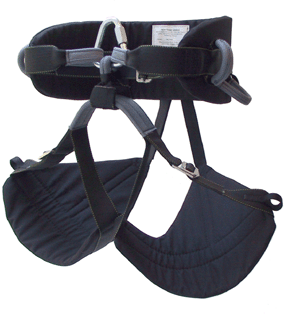
 Tree climbers use arborists' rope, which is different from rock-climbing rope, because it has less "give." You can't leave it in the tree all the time, because it will rot. So if you want to climb repeatedly, you set a static line in the tree in the setting you want, using a thin nylon cord that is impervious to the elements, and you haul your climbing rope up using that line. (I actually use plastic-covered clothesline; it's cheaper than zip line). Otherwise, you have to throw the line (using an arborists' throw bag) every time, and it's a skill I am only slightly good at. I set 4 lines, two each in two trees, the white oak Zemyna in my front yard, and the red oak Hannah in the back. So when I want to climb, it only takes a few moments to get my 1/2" rope into the tree and tie my climbing knots. Then I saddle up in my recreational saddle (the "Tengu" model at right), put on my helmet, hook on a water bottle, camera bag, notebook and gloves, and I go "on rope." I use locking carabiners to secure myself to the rope. 

One of the cardinal rules of tree climbing is that you never unhook from your rope while in the tree. If you obey that rule and tie your knots correctly, it's incredibly safe. The climbing technique I use is called DRT (double rope technique), and it uses a very ingenious knot called a modified Blake's hitch (the topmost knot in the photo at left) to allow the climber to ascend and descend easily. You pull yourself up using your own body weight (upper-body strength is necessary, but you mostly use your legs and your weight). I use a Prussik loop on the rope with my feet in it to literally pull the opposite end of the rope downward, which sends me upward. The Blake's hitch is scooted up by hand, and holds me in position. Eventually, I reach my destination branch, and after hanging out there a while, I decide if I want to switch branches and ascend higher, or descend. 

 Descent is simple and fun. You just grab the Blake's hitch and apply pressure on the top of it, and gravity will do the rest. A safety knot in the rope keeps me from plummeting too quickly, and if I get to going to fast, I just let go--and the knot holds. It's pretty clever. (A single rope technique, or SRT, exists too, but it is mostly used by more experienced climbers and for really, really tall--300 feet and up--trees like redwoods. SRT requires some different equipment and skills, and I never learned how to do it. DRT works fine for my trees, which are 80-100 feet tall.) It usually takes me about an hour from the time I decide to climb to when I'm on my destination branch. I usually go to a branch about 45-50 feet off the ground when I climb Hannah. Zemyna has more copious branches and a tighter canopy; when I climb her, you have to look hard for me in the summertime. (Can you see me ->?) 

 And what happens when I get there? Nothing. Blissful, quiet, cool...nothing. Being in the tree is indescribable, especially in the fall when the breezes are spectacular and the sky is so blue it almost makes you cry to look at it. You hear leaves rustling and the sound of your own breathing, birds chirping, and the creak of the branches. You can see your neighbors mowing their lawns or strolling by, and they can't see you (because they don't look). I admit that I like to call my dog and see how she'll react; she's not the brightest bulb in the chandelier, so she usually looks for me for quite a while before forgetting I exist (until I come down, and she has this relieved and puzzled expression I take to mean, "I thought I heard you calling me!"). Dusk is lovely, and climbing at night is even more thrilling. I haven't yet slept in the tree, though several companies make hammock-type apparati for doing just that. I'd like to put a semi-permanent pallet in Hannah, if I can figure out a way to do it without harming her. I have a Sky Chair that I will haul up and clip into a setting placed just for it. It's a great place to read or write or just think, which I do a lot of.
"Murmuring out of its myriad leaves, Down from its lofty top rising two hundred feet high, Out of its stalwart trunk and limbs, out of its foot-thick bark, That chant of the seasons and time, chant not of the past only, but the future." ~Walt Whitman, from Song of the Redwood Tree