Sorry for the cop-out, but I had to cross-post this.
This bit of WTF from Raised by Wolves has just about ruined my day.
It's bad enough that the cruelty is perpetuated, but the outrage is over what happened next.
Nothing.
The pictures are graphic. There are only three, but that's all that is needed. Be forewarned. The second and third ones are heartbreaking.
I have had more than one person who bought a dog from a pet store tell me s/he was told it came from "a reputable breeder." Well, if in their world "reputable" means vile, shameless, heartless and only in it for the money.
Since I tend toward the positive, especially when it comes to doggy stuff, you may ask why I posted this.
It wasn't to upset anyone. It's not gratuitous. It's to educate.
Wednesday, May 26, 2010


Thursday, May 13, 2010
"Don't Blame the Dog!"
A while back, I wrote a post about shelters and rescue groups not wanting to see the forest for the trees, and therefore were unwilling to properly screen dogs up for adoption, euthanize aggressive dogs, or admit that what they were doing was unethical, and bad for dogs.
I've been in a back-and-forth on an email list about this very subject the last few days, and it made me think of some more things to add to my diatribe.
Why are we not allowed to blame the dog, again? When dogs bite, and especially when they bite aggressively, with purpose to maim or worse, it is ALWAYS because the owners "did something wrong"?

They didn't socialize the dog when he was a puppy. They didn't train him. They overtrained him. They trained him too harshly. They trained him too wimpily. They used the wrong type of treat/training collar/leash/attitude. They fed him food with too much protein. They fed him from a stainless steel bowl, when they should have used plastic. They fed him from a plastic bowl. They fed him too much/too little/too often/not often enough. He was hungry. He was itchy. His feet hurt.
They crated him too much. They didn't crate enough. They let their kids tease him. They didn't let their kids interact with him enough to make him understand the kids were "in charge." They should never have gotten a dog because they had kids. Didn't they know Fido doesn't like kids?
The people worked too much, and were gone all the time. They didn't work enough, and were home all the time. They petted the dog too much. They didn't pet him enough. They paid too much attention to him. They didn't pay any attention to him. They tied him up. They didn't tie him up.
They named him a silly name. They didn't take him to the vet. They neutered him too early/too late/not at all. He wasn't vaccinated. He was over-vaccinated. They fed him Ol' Roy. They fed him top-of-the-line food, but it was crap because it wasn't raw food. They fed him raw food when he should have been eating kibble.
They dared to walk into the kitchen one day, nowhere near the dog's food bowl or toys, or the actual dog, and the dog launched himself across the floor and leapt up and went for the face of the teenage girl, and latched on, shaking back and forth, knocking her backward, and would not release despite her father beating him with a chair. He would not release until the hold on his collar made it hard for him to breathe, and he opened his mouth to get more air, and he was propelled backward. After the father shoved him across the kitchen and bent over his daughter--who had never done anything to the dog but interact normally with him--to try to stop the bleeding from the gash, the dog came back for more and the father had to cover his bleeding daughter's body and take several slashing bites to the back and arms before someone mercifully leashed the dog and threw him in his crate.
I KNEW I had left out something from the previous list of wrongs committed by this stupid, clueless, never-should-have-owned a dog family: walking into the kitchen!!
People are so dumb, right? How dare that girl walk into her own kitchen. She should have known better.
My brilliant, inspiring, and astute friend Sarah Wilson is, among other things, an author, trainer, teacher, lecturer, student of the human/animal bond, and wise sage when it comes to dogs and people. Her definition for serious aggression is the most succinct way I've ever come across to express it.
So, when a dog bites without warning over normal life events, whose fault is it?
It's not an easy question to answer, but I will not lay blame at the feet of the teenage girl walking into the kitchen.
Perhaps the family was inconsistent with this dog, and he was truly confused as to who was the leader in the home. Perhaps he absolutely believed he was ruler, and she had no right to cross "his" property without permission. Perhaps any number of things from the above laundry list of "sins" dog trainers often bemoan were happening in the house.
Maybe he had a brain tumor, or some other medical issue that contributed to his vicious, unprovoked attack. If they had just taken him to the vet and had a full blood workup done, the vet might have found something. Neurological disease? Cancer? Thyroid imbalance? These can all contribute to aggression.
 And perhaps, just perhaps, the dog was genetically wired wrong. Maybe it's the breeder's fault? Mother Nature? Zeus? Charles Darwin?
Does the picture above make you think, "Awww! How sweet!" or does it make you cringe?
A popular book amongst a subset of dog trainers (those who call themselves "positive" or "all positive") is Karen Pryor's Don't Shoot the Dog! Originally published in 1984 (I believe), it is a slim volume from a dolphin trainer-turned-dog-trainer that points out some of the misconceptions about dogs and behavior. It was the first book I remember reading that specifically exhorted dog owners to blame themselves for their dog's issues, not the dog. Other authors have done this, too--and for good reason. Most of our dogs' behavioral "problems" are indeed our fault. We are lousy communicators with species other than our own (and not even so great with our own, right?)
We get frustrated and angry at our dogs over things we should have trained them not to do. Dogs do not have morals or ethics, they simply have behaviors. Some of those are acceptable to us, and some are not. Training is about instilling the behaviors we want and teaching the dog to abstain from the behaviors we do not like. Since many of these "bad" behaviors are normal for dogs, it can be challenging sometimes.
Certainly, we cannot expect the dog to learn our language--we must learn his, and speak it to him.
When we fail to do this, problems can result, aggression among them.
So we must hang our heads in shame as a species for our arrogance at thinking the dog "knew better." After we flog ourselves, we need to get on with the business of being better communicators with our dogs. Modern dog training is about building relationships based on trust, and it allows humans and dogs to coexist quite peacefully the vast majority of the time.
But training cannot override everything. It cannot trump DNA or disease. When it squares off with genetics or medical issues, training by itself often does not come out victorious.
That is why blaming the dog is sometimes necessary, and when serious aggression is on the table, the dog must often pay with his life.
I know what it feels like to love a dog or two. And I know what it feels like to grow attached to dogs one does not own. I have been in the animal sheltering world for more than 10 years now, and working with animals for almost 30 years. I've loved and been attached to many dogs in my life.
I know what it is like to have to euthanize a dog I love who is no longer safe. The pain and heartache is overwhelming. Euthanasia of a beloved animal is never easy, but when the animal is in obvious pain, or simply no longer has a quality of life, at least we can clearly see the need to humanely end that life (and so can everyone else).
Euthanasia of aggressive animals is less clear-cut, so much so that I've had clients tell me their own trusted vet would not do perform the procedure on their dog after its aggression had reached unsafe levels. To the vet, the dog looked healthy. But the vet didn't have to live with what the dog had become. He or she did not have to walk around on eggshells in his or her own home because the family pet could "go off" at any given moment. Vets, like doctors, are taught to do everything possible to save lives, not destroy them.
Is the pain of euthanasia worse when one is made to feel guilty for it?
How do you think it feels to the family of the dog who attacked the teenage girl to be told by their vet that euthanasia is not appropriate for this dog, that they must have done something to provoke the dog, and that putting this dog down would not be fair to the dog? Perhaps the maimed young woman should be the one to, oh, I don't know, maybe take the "healthy" dog to an obedience class after she heals and get him the training he never got. Her scar(let letter)s could be an abject lesson for all to see: see what a lack of training gets you?
Until one has lived with a truly aggressive dog, has lived with the fear that the dog might hurt a family member or a friend or a stranger, or might escape the yard and maul a child, it is hard to imagine what it feels like. It's something that keeps decent people awake at night.
And from the often-grim insides of a rescue or shelter, teeming with unwanted animals that have, through no fault of their own, been cast off, treated poorly, abused, or simply neglected, the thought that the dog deserves another chance is not as uncommon as you would think.
After all, it's not his fault, right?
When it comes down to it, a homeless dog with a known bite history is a huge liability for anyone with which it has contact. Good shelters and rescue groups know this, and will not put up for adoption animals with known bite histories.
(NOTE: ANY dog with a bite history is a liability. But my main beef is with groups housing and adopting out homeless aggressive dogs, NOT owners who have such a dog and are trying to manage the situation while keeping the dog. That is still an issue, one based on personal choice that should never be taken lightly, but there is a difference.)
Fault is not the issue here--knowledge is. And knowledge can be a painful thing.
Good shelters understand that people deserve better than a pat, facile, "It's not his fault."
Some shelters and rescues who ignore this dictum and believe all dogs are salvageable claim to give "full disclosure" to adopters about the dog's history. They say that "some people want to adopt these damaged dogs, so we should let them." They think that disclosure will shield them from a lawsuit, but it won't.
And it wouldn't matter if it did. If the known biter bites again, more lives will be changed forever. The damage will be done.
Is it POSSIBLE to adopt out known biters and have them managed safely so that they never bite again? I suppose it could be. Is it ethical? I do not believe so. Is it kind? No. Are most adopters equipped to deal with this sort of dog for the rest of its life? No. Should they have to? No.
Some of these "rescuers" decide that Fierce Fido isn't safe for the average Joe, but he would be fine for a dog trainer to adopt and work with. How many of us do you think there are walking into shelters on a regular basis, looking for such a liability-er, project? Very few--we already have multiple dogs.
Doing something unethical and quite possibly dangerous "because some people want to" is not a recipe for a successful enterprise. And, here's a shocker--MOST people do NOT want it. They don't want to own an aggressive dog, they don't want to live next to an aggressive dog, and they don't want aggressive dogs in their neighborhoods.
So these "save 'em all" rescue groups are endangering the majority to make themselves (and the mysterious "people who want to") feel better. Since it's never the dog's fault, they think what they are doing is humane. But what they are really doing is eroding the rights of dog owners, little by little. They are creating a culture of fear with dogs, so that children are growing up afraid of dogs--a fate that should not be visited on anyone, much less a child. These groups are turning people away from adoption (or dog ownership in general) in tiny little increments, which affects all animals in shelters. It has been said that only 10% of the animals in people's homes came from shelters. Do we want that number to decrease even more?
(And that leads us down another slippery path towards the "Abuse Excuse" and its ramifications.)
The truth is that some dogs are just not pet material. And until shelters and rescues get their emotions pushed aside for just a minute and realize how their inaction with aggressive dogs ripples out community-wide in mostly negative ways, they will continue to blame the owners, the breeders, the pet store proprietor, the puppymiller, and Jesus, Joseph and Mary for the dog's aggression.
It may not usually be the dog's fault, but it is all our problem.
I've been in a back-and-forth on an email list about this very subject the last few days, and it made me think of some more things to add to my diatribe.
Why are we not allowed to blame the dog, again? When dogs bite, and especially when they bite aggressively, with purpose to maim or worse, it is ALWAYS because the owners "did something wrong"?

They didn't socialize the dog when he was a puppy. They didn't train him. They overtrained him. They trained him too harshly. They trained him too wimpily. They used the wrong type of treat/training collar/leash/attitude. They fed him food with too much protein. They fed him from a stainless steel bowl, when they should have used plastic. They fed him from a plastic bowl. They fed him too much/too little/too often/not often enough. He was hungry. He was itchy. His feet hurt.
They crated him too much. They didn't crate enough. They let their kids tease him. They didn't let their kids interact with him enough to make him understand the kids were "in charge." They should never have gotten a dog because they had kids. Didn't they know Fido doesn't like kids?
The people worked too much, and were gone all the time. They didn't work enough, and were home all the time. They petted the dog too much. They didn't pet him enough. They paid too much attention to him. They didn't pay any attention to him. They tied him up. They didn't tie him up.
They named him a silly name. They didn't take him to the vet. They neutered him too early/too late/not at all. He wasn't vaccinated. He was over-vaccinated. They fed him Ol' Roy. They fed him top-of-the-line food, but it was crap because it wasn't raw food. They fed him raw food when he should have been eating kibble.
They dared to walk into the kitchen one day, nowhere near the dog's food bowl or toys, or the actual dog, and the dog launched himself across the floor and leapt up and went for the face of the teenage girl, and latched on, shaking back and forth, knocking her backward, and would not release despite her father beating him with a chair. He would not release until the hold on his collar made it hard for him to breathe, and he opened his mouth to get more air, and he was propelled backward. After the father shoved him across the kitchen and bent over his daughter--who had never done anything to the dog but interact normally with him--to try to stop the bleeding from the gash, the dog came back for more and the father had to cover his bleeding daughter's body and take several slashing bites to the back and arms before someone mercifully leashed the dog and threw him in his crate.
I KNEW I had left out something from the previous list of wrongs committed by this stupid, clueless, never-should-have-owned a dog family: walking into the kitchen!!
People are so dumb, right? How dare that girl walk into her own kitchen. She should have known better.
My brilliant, inspiring, and astute friend Sarah Wilson is, among other things, an author, trainer, teacher, lecturer, student of the human/animal bond, and wise sage when it comes to dogs and people. Her definition for serious aggression is the most succinct way I've ever come across to express it.
"When normal life events cause offensive aggression with little or no warning, that dog is not a pet." ~Sarah Wilson
So, when a dog bites without warning over normal life events, whose fault is it?
It's not an easy question to answer, but I will not lay blame at the feet of the teenage girl walking into the kitchen.
Perhaps the family was inconsistent with this dog, and he was truly confused as to who was the leader in the home. Perhaps he absolutely believed he was ruler, and she had no right to cross "his" property without permission. Perhaps any number of things from the above laundry list of "sins" dog trainers often bemoan were happening in the house.
Maybe he had a brain tumor, or some other medical issue that contributed to his vicious, unprovoked attack. If they had just taken him to the vet and had a full blood workup done, the vet might have found something. Neurological disease? Cancer? Thyroid imbalance? These can all contribute to aggression.
 And perhaps, just perhaps, the dog was genetically wired wrong. Maybe it's the breeder's fault? Mother Nature? Zeus? Charles Darwin?
Does the picture above make you think, "Awww! How sweet!" or does it make you cringe?
A popular book amongst a subset of dog trainers (those who call themselves "positive" or "all positive") is Karen Pryor's Don't Shoot the Dog! Originally published in 1984 (I believe), it is a slim volume from a dolphin trainer-turned-dog-trainer that points out some of the misconceptions about dogs and behavior. It was the first book I remember reading that specifically exhorted dog owners to blame themselves for their dog's issues, not the dog. Other authors have done this, too--and for good reason. Most of our dogs' behavioral "problems" are indeed our fault. We are lousy communicators with species other than our own (and not even so great with our own, right?)
We get frustrated and angry at our dogs over things we should have trained them not to do. Dogs do not have morals or ethics, they simply have behaviors. Some of those are acceptable to us, and some are not. Training is about instilling the behaviors we want and teaching the dog to abstain from the behaviors we do not like. Since many of these "bad" behaviors are normal for dogs, it can be challenging sometimes.
Certainly, we cannot expect the dog to learn our language--we must learn his, and speak it to him.
When we fail to do this, problems can result, aggression among them.
So we must hang our heads in shame as a species for our arrogance at thinking the dog "knew better." After we flog ourselves, we need to get on with the business of being better communicators with our dogs. Modern dog training is about building relationships based on trust, and it allows humans and dogs to coexist quite peacefully the vast majority of the time.
But training cannot override everything. It cannot trump DNA or disease. When it squares off with genetics or medical issues, training by itself often does not come out victorious.
That is why blaming the dog is sometimes necessary, and when serious aggression is on the table, the dog must often pay with his life.
I know what it feels like to love a dog or two. And I know what it feels like to grow attached to dogs one does not own. I have been in the animal sheltering world for more than 10 years now, and working with animals for almost 30 years. I've loved and been attached to many dogs in my life.
I know what it is like to have to euthanize a dog I love who is no longer safe. The pain and heartache is overwhelming. Euthanasia of a beloved animal is never easy, but when the animal is in obvious pain, or simply no longer has a quality of life, at least we can clearly see the need to humanely end that life (and so can everyone else).
Euthanasia of aggressive animals is less clear-cut, so much so that I've had clients tell me their own trusted vet would not do perform the procedure on their dog after its aggression had reached unsafe levels. To the vet, the dog looked healthy. But the vet didn't have to live with what the dog had become. He or she did not have to walk around on eggshells in his or her own home because the family pet could "go off" at any given moment. Vets, like doctors, are taught to do everything possible to save lives, not destroy them.
Is the pain of euthanasia worse when one is made to feel guilty for it?
How do you think it feels to the family of the dog who attacked the teenage girl to be told by their vet that euthanasia is not appropriate for this dog, that they must have done something to provoke the dog, and that putting this dog down would not be fair to the dog? Perhaps the maimed young woman should be the one to, oh, I don't know, maybe take the "healthy" dog to an obedience class after she heals and get him the training he never got. Her scar(let letter)s could be an abject lesson for all to see: see what a lack of training gets you?
Until one has lived with a truly aggressive dog, has lived with the fear that the dog might hurt a family member or a friend or a stranger, or might escape the yard and maul a child, it is hard to imagine what it feels like. It's something that keeps decent people awake at night.
And from the often-grim insides of a rescue or shelter, teeming with unwanted animals that have, through no fault of their own, been cast off, treated poorly, abused, or simply neglected, the thought that the dog deserves another chance is not as uncommon as you would think.
After all, it's not his fault, right?
When it comes down to it, a homeless dog with a known bite history is a huge liability for anyone with which it has contact. Good shelters and rescue groups know this, and will not put up for adoption animals with known bite histories.
(NOTE: ANY dog with a bite history is a liability. But my main beef is with groups housing and adopting out homeless aggressive dogs, NOT owners who have such a dog and are trying to manage the situation while keeping the dog. That is still an issue, one based on personal choice that should never be taken lightly, but there is a difference.)
Fault is not the issue here--knowledge is. And knowledge can be a painful thing.
Good shelters understand that people deserve better than a pat, facile, "It's not his fault."
Some shelters and rescues who ignore this dictum and believe all dogs are salvageable claim to give "full disclosure" to adopters about the dog's history. They say that "some people want to adopt these damaged dogs, so we should let them." They think that disclosure will shield them from a lawsuit, but it won't.
And it wouldn't matter if it did. If the known biter bites again, more lives will be changed forever. The damage will be done.
Is it POSSIBLE to adopt out known biters and have them managed safely so that they never bite again? I suppose it could be. Is it ethical? I do not believe so. Is it kind? No. Are most adopters equipped to deal with this sort of dog for the rest of its life? No. Should they have to? No.
Some of these "rescuers" decide that Fierce Fido isn't safe for the average Joe, but he would be fine for a dog trainer to adopt and work with. How many of us do you think there are walking into shelters on a regular basis, looking for such a liability-er, project? Very few--we already have multiple dogs.
Doing something unethical and quite possibly dangerous "because some people want to" is not a recipe for a successful enterprise. And, here's a shocker--MOST people do NOT want it. They don't want to own an aggressive dog, they don't want to live next to an aggressive dog, and they don't want aggressive dogs in their neighborhoods.
So these "save 'em all" rescue groups are endangering the majority to make themselves (and the mysterious "people who want to") feel better. Since it's never the dog's fault, they think what they are doing is humane. But what they are really doing is eroding the rights of dog owners, little by little. They are creating a culture of fear with dogs, so that children are growing up afraid of dogs--a fate that should not be visited on anyone, much less a child. These groups are turning people away from adoption (or dog ownership in general) in tiny little increments, which affects all animals in shelters. It has been said that only 10% of the animals in people's homes came from shelters. Do we want that number to decrease even more?
(And that leads us down another slippery path towards the "Abuse Excuse" and its ramifications.)
The truth is that some dogs are just not pet material. And until shelters and rescues get their emotions pushed aside for just a minute and realize how their inaction with aggressive dogs ripples out community-wide in mostly negative ways, they will continue to blame the owners, the breeders, the pet store proprietor, the puppymiller, and Jesus, Joseph and Mary for the dog's aggression.
It may not usually be the dog's fault, but it is all our problem.
Wednesday, May 5, 2010
Reciprocity
From someone named Ben, on a blog I frequent:
I must be a lousy guest. And I never knew.
I generally refuse offers of things out of a sense of duty: thou shalt not maketh they host wait on thee hand and foot. I feel like I'm imposing if I actually accept something being offered to me upon arrival at someone's home.
Host says, "Can I get you anything? A stiff drink? Soda? Water?"
Me, completely parched to the bone, croaks, "No, thanks. I drank some three days ago," and then I collapse from dehydration.
Seriously, I was taught to refuse offers (and I will not be swayed by Mafioso) because one didn't want to be any bother. I was also taught to say "Yes, Sir" and "No, Ma'am," which I still do to this day, though the line is blurring as to whom it is appropriate to say that, now that I am "of a certain age." And in the spirit of "Bless your heart" (which I could never bring myself to adopt), I learned to say "Wow, that's interesting" when what I was really thinking was, "You gotta be freaking kidding me!"
I guess I never considered that it was rude to not accept. Of course, I knew that some hosts insist until you give in, and what can you do when that happens? Not much. They win. Drink up, Sweetheart.
I actually have a philosophy about it now, especially if what is being offered is of great value. Politely refuse once, and thank them. When it is offered again, politely refuse again. You need to be serious, not coy. You are turning the offer down because It's Too Much.
If they go away, and after long enough to have considered it (like days, not minutes), offer a third time, then jump on that train, Sister! If I give you 2 full, honest refusals, and you offer again, then I very well might accept. So...if you want me to have something, you may have to wear me down.
But how about the ones who only offer once? Or maybe offer again a little later? Isn't it possible they are secretly hoping you'll be polite and refuse them?
If so, don't offer it to me more than twice.
What about you?
This also reminds me of a similar revelation I had a while back: a person who says “no, thank you, I’m fine” all the time makes for a lousy guest. The dance of giving and receiving is what brings us together, and “being no bother” is actually just a recipe for estrangement.
I must be a lousy guest. And I never knew.
I generally refuse offers of things out of a sense of duty: thou shalt not maketh they host wait on thee hand and foot. I feel like I'm imposing if I actually accept something being offered to me upon arrival at someone's home.
Host says, "Can I get you anything? A stiff drink? Soda? Water?"
Me, completely parched to the bone, croaks, "No, thanks. I drank some three days ago," and then I collapse from dehydration.
Seriously, I was taught to refuse offers (and I will not be swayed by Mafioso) because one didn't want to be any bother. I was also taught to say "Yes, Sir" and "No, Ma'am," which I still do to this day, though the line is blurring as to whom it is appropriate to say that, now that I am "of a certain age." And in the spirit of "Bless your heart" (which I could never bring myself to adopt), I learned to say "Wow, that's interesting" when what I was really thinking was, "You gotta be freaking kidding me!"
I guess I never considered that it was rude to not accept. Of course, I knew that some hosts insist until you give in, and what can you do when that happens? Not much. They win. Drink up, Sweetheart.
I actually have a philosophy about it now, especially if what is being offered is of great value. Politely refuse once, and thank them. When it is offered again, politely refuse again. You need to be serious, not coy. You are turning the offer down because It's Too Much.
If they go away, and after long enough to have considered it (like days, not minutes), offer a third time, then jump on that train, Sister! If I give you 2 full, honest refusals, and you offer again, then I very well might accept. So...if you want me to have something, you may have to wear me down.
But how about the ones who only offer once? Or maybe offer again a little later? Isn't it possible they are secretly hoping you'll be polite and refuse them?
If so, don't offer it to me more than twice.
What about you?
Saturday, May 1, 2010
The Best Gift You'll Ever Give

I'm sure no one who enjoys the company of dogs will find this surprising.
Many people would prefer to have conversations with their dogs than with their spouses.
It's not because dogs are wittier, have a greater grasp of the language, or will answer thorny philosophical questions.
It's because they listen. Or, we think they listen. Regardless, they give off the appearance of rapt attention, and as humorist Dave Barry says, "You can say any fool thing to a dog, and the dog will give you this look that says, 'My God, you're right! I never would've thought of that!'"
That's why we like to talk to dogs. (Though I confess I talk to my dogs not because I think they listen to my ramblings, but because I amuse myself by talking to them. I also talk to myself a lot, so there you go.) I'm sure people have other reasons, too.
"The dog is a yes-animal. Very popular with those who cannot afford a yes-man." ~Robertson Davies
But this story brings up a better question for me. Why don't we humans listen better to our loved ones? Many of us pay rapt attention to inconsequential stuff: pop music lyrics, TV shows, sports statistics, snippets about celebrities. Some of us also pay attention to teachers, and other sources of education. What one chooses to pay attention to depends on what one values. It also depends on what one hears frequently, or less frequently. It's easy to "tune out" conversations with our loved ones because they seem to become repetitive, or we find them mundane.
 Unfortunately,
 "tuning out" those we care about--those we should be listening to--sends a message we probably do not want to send. It says to those people that we don't care, or that we have better things to do.
This is hurtful and depressing, and it definitely doesn't help our relationships. Becoming a better listener can change your relationships immensely, and improve your life.
Try this experiment.
The next time your partner, husband, wife, sibling, parent, lover, girlfriend, boyfriend, your child, or a trusted friend asks (or just begins) to speak with you, do the following.
Put down everything your hands are busy with. This means your computer, phone, coffee cup, paper, pen, Wii controller, whatever. Stop touching it. If it is going to tempt you, put it away.
If the person is sitting, you should sit across from them. If they are standing, you should stand across from them, or invite them to sit.
Face the person, and put your empty hands on the table, or on your lap, loosely clasped. If you are standing, they should be at your sides loosely. Do NOT put them in your pockets, or hide them in any way. Do NOT cross your arms in front of your chest.
Your hands should be visible, empty, and still.
Stand or sit comfortably, back straight, but not rigid. You should be comfortable, but not slouchy. Face the person directly, and look them in the eyes, warmly.
Now, here's the tricky part.
LET. THEM. SPEAK. Do not interrupt. Keep your expression relaxed, but attentive.
LISTEN FULLY. You may not know how to do this, because if you are like most people, you have lost the ability to do it. It's like a muscle--you use it, or you lose it.
You can get it back. Starting now.
Wipe your mind clear--as much as possible--of all thoughts that do not pertain to what the speaker is saying. Do not think about work, or to-do lists, gossip, or what is happening later that day. Ignore your worries. Do not daydream.
Do not think of questions to ask the speaker when s/he is finished. Do not think of what you will say in reply to his or her statements.
Just pay attention, and listen.
Pay attention to the speaker as if your life depends upon absorbing what s/he is saying. No matter how mundane the topic seems (or actually is), your job right then is to hear it, and hear it fully.
When the speaker has finished their thought, or story, you can do one of two things.
If you are pressed for time, smile, and say "thank you" with genuine warmth, then go about the rest of your day. Your experiment is finished.
If you are not pressed for time (and really, can you not make a little bit of time for this?), do the following.
When s/he finishes speaking, count slowly to 5 (to yourself, silly). There should be a marked pause here. Smile. If the end of their speech did not contain a question you need to answer, lean forward just a little, continuing to look them warmly in the eye, and say, "Tell me more."
I don't care how silly, dumb, old, tired, or ridiculous the topic was. Ask them to tell you more. It wasn't silly, dumb, old, tired, or ridiculous to them.
This is someone you love. Someone who gave birth to you, or fathered you, or to whom you gave birth, or fathered, or you have known a long time, or with whom you are intimate. This is someone who knows you, and loves you. This is someone you cherish. This is someone important, someone without which you would not be the person you are right now. This person matters. And what they think, and say, also matters.
Doesn't it?
This exercise is simple to do. It doesn't take hardly any extra time. And you know what? It changes things. When you make the conscious choice to start listening, really listening, to your loved ones, your life will change, and so will theirs.
You don't have to do this with every person you talk to. Reserve it for loved ones who need to tell a story, or convey information. Do it once, and see if you don't want to do it more often.
Extra Credit: the teacher in me wants to give you a chance to excel. So here are 2 things that will put the cherry and whipped topping on this exercise.
1. When the above exchange is over, and you are alone again, get a pen and a notebook or sheet of paper and write down what transpired. You can write a synopsis of the conversation, or just how it made you feel. You can make notes of how it seemed to affect the speaker (if you noticed at all). You can write that it frustrated you, or bored you, or made you think. You don't have to be Tolstoy; no one will read this but you (and your heirs after you are dead--ha ha). Just write it down.
2. About 5-7 days later, approach the speaker with purpose, and ask them about the story. You might say something like, "That incident you told me about with your boss...how did that turn out?" Or, "have you made up your mind about college yet?" Or, "I was wondering if you were feeling better since our talk about Joe's illness, and how it was affecting you." Inquire about it because you want to know, and because you remember the conversation. And listen to their reply, just like you listened the first time.
"Excellence is not an act, but a habit. We are, therefore, what we repeatedly do." ~Aristotle
More on this topic to come. Let me know how the experiment goes for you.
Monday, April 26, 2010
Roll the Bones
I remember being about 9 years old and accompanying my mom to the local Ben Franklin "Five and Dime" store. I believe the company is gone now (though a few stores may still exist in small towns by that name), but younger and more urbanly hip readers are familiar with the concept of the "dollar" store, now seen almost everywhere.
It's not the same. Maybe I have a selective memory, but today's "dollar" stores seem riddled with cheap depressing crap no one really wants (including the manufacturer), while variety stores from my youth had cheap crap a lot of people actually wanted, and used.
 The Ben Franklin at our local strip mall was one of my very favorite places to go. I remember buying those balsa wood airplanes every summer, and I still have a fondness for their incredibly simple, rubber-band propellor technology today. And the store itself wasn't large, but it was dark and cool, and Mom would let me wander to decide what trinket I needed to have that very minute. Meanwhile, she bought sewing notions, a hook-and-eye loop for the screen door, a turkey lifter, and a plunger. Was there something the store didn't have? It seemed to my child's imagination that Ben Franklin had tons of stuff.
But not as much stuff as one can find at most every store today. And therein lies the problem. We simply have too many choices. And having too many choices can leave us overwhelmed and anxious.
I wish I could explain this as well as Cath Duncan does in this blog post. But I can't. So go read it, and come back. Because it relates to choosing a pet.
How having too many choices relates to pet acquisition
To paraphrase Cath's post, we use our left-brain to weigh the pros and cons of daily choices, and this works well for us, unless there are too many choices. Then, we start second-guessing our choices, which actually, according to Dan Gilbert, reduces our happiness. It seems weird, but from a personal standpoint, I can totally relate.
And it can affect all parts of our lives, even down to the pet we choose in an animal shelter. Oddly, I had always thought this was because of our pesky emotions, which definitely play a part in our decisions when it comes to animals. But Cath points out that using our emotions can help when there are too many choices. I don't have hard scientific evidence to prove my hypothesis, but when the shelter at which I work is at full capacity for adult dogs, adoptions plateau, then start falling off. Price or perceived value becomes moot (because many shelters lower prices when this happens, in an attempt to "move the merchandise"), and many "lookers" actually leave having truly only looked.
If you asked people as they were leaving why they didn't adopt a pet today, "you had too many to choose from" would not be their answer. I suspect it's unconscious, actually. They felt overwhelmed, but they don't really know why.
When a number of cages are left empty, adoptions increase. There are other factors that play into it, too: weather, the economy, time of year, how many black dogs are in the shelter, and the animals' behavior, to name a few. How clean the place is also affects adoptions, and the more dogs that reside there, the harder it is for staff to keep the shelter clean.
Overall, it does seem to hold true that too many choices of potential pets will stymie the "average" adopter. It's bad enough when you are looking at cans of tomato sauce, or brands of toilet paper, but when you throw homeless pets into the choice pools, people's already frazzled emotions take a huge hit.
(I will explore this emotional link regarding shelters in a future post. I've got lots of theories about it.)
It is often said that life was easier "back in the day" (an idea that minorities would vehemently disagree with), in part because there weren't more than a couple of choices we faced every day. I can see how this might have been true. From brands of products to how to live our lives, not having to analyze everything must have been a relief.
 Technology has improved our lives immensely, but at what price? If adoptions decrease when one has too many dogs to pick from, then dogs stay in the shelter longer, which increases the chances that stress will degrade their behavior and health--even in the best-run facilities.
That doesn't mean adopters should make uninformed choices, but the opposite of that is not making a choice at all. And Neil Peart very brillantly had something to say about that.
It's not the same. Maybe I have a selective memory, but today's "dollar" stores seem riddled with cheap depressing crap no one really wants (including the manufacturer), while variety stores from my youth had cheap crap a lot of people actually wanted, and used.
 The Ben Franklin at our local strip mall was one of my very favorite places to go. I remember buying those balsa wood airplanes every summer, and I still have a fondness for their incredibly simple, rubber-band propellor technology today. And the store itself wasn't large, but it was dark and cool, and Mom would let me wander to decide what trinket I needed to have that very minute. Meanwhile, she bought sewing notions, a hook-and-eye loop for the screen door, a turkey lifter, and a plunger. Was there something the store didn't have? It seemed to my child's imagination that Ben Franklin had tons of stuff.
But not as much stuff as one can find at most every store today. And therein lies the problem. We simply have too many choices. And having too many choices can leave us overwhelmed and anxious.
I wish I could explain this as well as Cath Duncan does in this blog post. But I can't. So go read it, and come back. Because it relates to choosing a pet.
How having too many choices relates to pet acquisition
To paraphrase Cath's post, we use our left-brain to weigh the pros and cons of daily choices, and this works well for us, unless there are too many choices. Then, we start second-guessing our choices, which actually, according to Dan Gilbert, reduces our happiness. It seems weird, but from a personal standpoint, I can totally relate.
And it can affect all parts of our lives, even down to the pet we choose in an animal shelter. Oddly, I had always thought this was because of our pesky emotions, which definitely play a part in our decisions when it comes to animals. But Cath points out that using our emotions can help when there are too many choices. I don't have hard scientific evidence to prove my hypothesis, but when the shelter at which I work is at full capacity for adult dogs, adoptions plateau, then start falling off. Price or perceived value becomes moot (because many shelters lower prices when this happens, in an attempt to "move the merchandise"), and many "lookers" actually leave having truly only looked.
If you asked people as they were leaving why they didn't adopt a pet today, "you had too many to choose from" would not be their answer. I suspect it's unconscious, actually. They felt overwhelmed, but they don't really know why.
When a number of cages are left empty, adoptions increase. There are other factors that play into it, too: weather, the economy, time of year, how many black dogs are in the shelter, and the animals' behavior, to name a few. How clean the place is also affects adoptions, and the more dogs that reside there, the harder it is for staff to keep the shelter clean.
Overall, it does seem to hold true that too many choices of potential pets will stymie the "average" adopter. It's bad enough when you are looking at cans of tomato sauce, or brands of toilet paper, but when you throw homeless pets into the choice pools, people's already frazzled emotions take a huge hit.
(I will explore this emotional link regarding shelters in a future post. I've got lots of theories about it.)
It is often said that life was easier "back in the day" (an idea that minorities would vehemently disagree with), in part because there weren't more than a couple of choices we faced every day. I can see how this might have been true. From brands of products to how to live our lives, not having to analyze everything must have been a relief.
 Technology has improved our lives immensely, but at what price? If adoptions decrease when one has too many dogs to pick from, then dogs stay in the shelter longer, which increases the chances that stress will degrade their behavior and health--even in the best-run facilities.
That doesn't mean adopters should make uninformed choices, but the opposite of that is not making a choice at all. And Neil Peart very brillantly had something to say about that.
Wednesday, April 14, 2010
Embarking on the Obedience Train
 Would you agree that stability and clear communication in relationships lead to their success? Then you should agree that trained dogs are happier than untrained dogs. Trained dogs’ lives are more stable and consistent, and they are rarely sent to shelters for behavioral problems. They are part of the family, rather than relegated to a boring backyard or crated most of the time. Since training your dog is so essential, one wonders why anyone would want to have an untrained pooch!
 The sad fact is that many people are more willing to give up their dog instead of putting effort into training. Perhaps they are put off by the cost or effort required (often, the perceived cost or effort is greater than the actual cost and effort), or they simply think their dog doesn’t need manners. Whatever the reason, untrained dogs are suffering because of it. Finding a trainer who will work with you and your pooch effectively isn’t difficult, but it is essential to know what you need and where to look. Refusing to train the dog is simply not an option–-if one day you can’t live with him because of his behavior, why expect someone else to?
 To canine professionals, training is not a luxury. It's a necessity. We have brought dogs into our lives on purpose, and there is no doubt that they have enriched the human race in immeasurable ways. When you realize that enriching their lives by simply showing them the proper way to behave in our lives takes so little time and effort, you will wonder why you didn't do it sooner. Training provides stability and purpose for dogs, many of whom are no longer performing the jobs that they were originally bred to do. It also gives them freedom.
As for what the "right" way to train is, there is one maxim to remember: no tool or method works for every dog. Dogs and their owners are individuals working as a team, and what works for one “team” may not work for another. It may take some trial and error to find just the right tools and methods, but once you do, your dog will thank you for it, and your relationship will be much enhanced.
All dogs need a leader and a set of rules to follow in order to fit well into the household. A competent trainer will be able to match your needs and the dog’s needs to tools and methods that work best for you. He or she will also be friendly, helpful, accessible, and care about what you need and want, in addition to making sure you are meeting your dog's actual needs. Training should be interesting and enjoyable for both you and the dog. Your dog should improve after just a few sessions, and you doing your homework.
Here are some pros and cons of the four basic training setups.
Do-it-yourself
Pros:
1. If it works for you, it's cheapest; minimal money outlay is mostly for books/video and training tools
2. You are building the relationship with the dog; dog learns to work for you
3. It can be done at your convenience in the place of your choice and at your pace
Cons:
1. The method you choose may not work for your dog; books and manuals vary widely in approach and cannot always answer your questions
2. No professional is on hand to make sure you are doing right by the dog and the dog is actually learning what he is supposed to be learning (no feedback)
3. No professionally-supervised socialization or distractions
 Classes
 Pros
1. Typically it's the least expensive of professional help options
2. Shows you how to teach your own dog; dog learns to work for you
3. The better ones contain a beneficial socialization component, and the added distractions of class prepare the dog for “real life” situations
4. You get to meet and speak with folks “in the same boat” as you–-you learn you are not alone, and you can meet some fellow dog-lovers
5. Allows for lots of training opportunities, including doggy sports like agility and flyball

Cons
1. The method they teach may not work for your team; instructors can vary widely in approach and teaching skills, and may forbid certain tools or methods that could work for you
2. Little individualized instruction; multiple class attendees means less attention per team
3. Not suitable for aggressive animals and won’t always work for major problem behaviors
4. Scheduling and geography may not jell with your needs
Private lessons (usually held in your home)
Pros:
1. Individualized instruction is tailored to your dog’s (and your) needs
2. The dog learns to work for you with the aid of professional help
3. It can be done usually at your convenience in your home and at your pace
4. Problem behaviors have best chance of being solved
Cons:
1. The method the trainer uses may not work for your dog or you (though a quality trainer will figure out the best way to get results)
2. One of the more expensive training options, and once you've paid for it, you may feel obligated to keep using the trainer even if it isn't working
3. It has less chances for socialization than classes
4. Regular “home” distractions (phones, kids, etc.) may lessen your chance of success
Board-and-train (B&T)
Pros:
1. Provides individualized instruction tailored to your dog’s needs
2. Your dog gets the basic foundation from a professional, away from the distractions of your home
3. Great for dogs that need to be boarded during the time they should be getting trained (i.e., crucial learning periods)
4. Most of the "startup" work is done for you
Cons:
1. It can be expensive
2. Dog is learning to work for the trainer, not you; you may not get good follow-up once the boarding has ended and find that the dog doesn’t behave at home
3. Most of the work is done for you, so your relationship with your dog is not growing
4. You cannot watch how your pet is handled or trained or socialized
When choosing trainers, ask questions! A quality trainer is one who is experienced, knowledgeable, makes you feel comfortable, likes your dog, is flexible and willing to use the tools or methods that work best for your dog and you, and who gets the job done to your satisfaction. After all, YOU have to live with the dog.

Word-of-mouth referrals are the best way to find a good trainer. Ask for references, length of experience, and what types of dogs and behaviors they've dealt with. Avoid a "high-pressure" tactic to get you to sign up, and avoid franchises with "too-good-to-be-true" guarantees. These often mask a lack of experience, and can inflate the training's price--and may do you absolutely no good. Caveat emptor.
P.S. Remember to take what you see on TV in regards to dog training with a grain of salt. Some of it works, some of it is just for show, some of it isn't even training. Plus, you don't know what ended up on the cutting-room floor. Though TV would like us to think differently, problems are never solved in one hour or less.
Training takes patience and time. Good training is efficient, but it cannot be rushed. Your dog has had weeks, months, or even years to build up his habits. It may take some time to erase them, and replace them with better ones.
If you don't have the patience for this, you should have gotten a cat. Or a guinea pig. Or a hamster. Or a fish. I'm just sayin'.
Monday, April 5, 2010
Why I love Max and Maira

"I want to say
That wonderful ideas
Can come fom anywhere.
Sometimes you make a mistake,
or break something,
or lose a hat,
and the next thing you know,
you get a great idea."
~Max Stravinsky
Max is a poet, and a dreamer. He is also a dog.
Max is the hero of several children's books by the witty and wonderful Maira Kalman, whose drawings have appeared on the cover of the New Yorker for years, and hilariously decorate the pages of The Elements of Style (apparently, she went into a store one day, picked up a copy of the book, and decided that it needed pictures), as well as non-Max books and several lovely year-long blog projects for the New York Times (I am so hoping she will revive her blogging). The most recent is "The Pursuit of Happiness," from 2009. It will be released as a book this year.
Max is the dog everyone wishes they could be. That's why I love him.
"Good things come out of incomprehension." ~from "Illustrated Woman" TED video, October, 2007
Maira doesn't believe in talking down to kids. I don't have children, can't have them, and have never wanted them, but the fact that she doesn't talk down to them gives me hope. Most kids are way smarter than given credit for. Many parents think they have to "dumb things down" for their kids, but I find that to be tiresome and pedantic. I think children should be exposed to things that make no sense to them yet. I think it widens their brains. Like puppies, they are sponges, soaking up the world in little bits and bytes. You never know what will stick.
(That said, my never-to-be-born children would have grown tired of me, always offering them art and literature that was too advanced for them, and expecting them to like it. "Just because you loved Romeo and Juliet when you were 11 and practically memorized the whole play doesn't mean we have to. I wanna play Pokemon!" I would then grumble and sigh and say something like, "When I was your age..." and they'd tune me out. So, better to be sans children--I'm sure their taste in art would have bored me.)
Readers understand the incredible power of literature, and I do believe that kids reading a bit over their heads makes them better readers, and enjoyers of the printed page. Kalman's "Max" stories are poetic and use words most kids (and many adults, albeit typically not the ones reading her work) don't hear on a daily basis--words like pluperfect, ruminations, and debonnaire. Her character's names are delicious. (I so hope one day to meet a Mr. Hoogenschmidt.) One has the lovely moniker Ferrrnando Extra Debonnaire....great name for a dog.
Speaking about the seminal writer's style manual for the ages, Strunk and White's The Elements of Style, she muses,
"E.B. White wrote a number of rules which can either paralyze you and make you loathe him for the rest of time, or, you can ignore them, which I do, or you can, I don't know what--eat a sandwich."
 Kalman's text in her kid's books scrolls wildly on the pages, too, which has a certain "to hell with you, typesetter" quality to it. It wraps dangerously around her drawings, clinging to them precariously on some pages. I LOVE THIS. It satisfies me like a nice rare steak at the end of an emotionally trying day.
You know what else I love about Maira? She takes photos of oddities, or everyday objects, and then draws pictures of them and thinks up captions. I can't paint, but I do like oddities, or the art of the absurd.
 She uses words purposefully, and yet, with abandon. If I was ever able to meet her I would surely babble like a schoolgirl and bow down like a subject humbled before the crown. I'm embarrassed just considering the thought.
If you haven't seen her work, you are missing out. Besides the Max adventures (including my favorite, Swami on Rye: Max in India), check out Smartypants: Pete in School and Sayonara, Mrs. Kackleman. The Principles of Uncertainty is a classic.
.
 (above) From "The Pursuit of Happiness" blog.
Kalman's bibliography on Amazon
Definitely worth a watch: Maira Kalman, the illustrated woman | Video on TED.com
Saturday, April 3, 2010
Rescue Remedy

"Better to light a candle for one lost dog than to curse the darkness of man's indifference. Saving just one dog won't change the world, but it surely will change the world for that one dog." - Richard C. Call
Given the vast numbers of homeless dogs in this country, one understands why there are countless groups who are trying to help them. There are thousands of shelters or rescue groups in this country (no one knows how many for sure, as there is no agency that unites them all--despite the Humane Society of the United States' ploy to make their donors think there is). Some operate shelters, others do not. Some set up shop at local pet stores and other venues in an attempt to place dogs. Most utilize foster homes and large networks of volunteers to do, ostensibly, what’s best for dogs.
But sometimes, people look past the forest and see only the trees. Not all rescues or adoptive agencies are the same. Some are great places to get a “recycled” dog, and others should never be handling animals at all. This latter group includes shelters or rescues who do not put an emphasis on temperament, and therefore adopt out (or keep caged for life) known aggressive animals in an attempt to “save them all”; who do little or no screening of adopters, or are too strict and unyielding in their screening of adopters; who do not understand how to run nonprofit organizations, and therefore waste money and time; and who are “all about the dogs” while treating most people with suspicion or utter contempt.

A friend of mine was once refused adoption of a dog that would have been perfect for her because--I am not making this up--she “might decide to get pregnant one day and have kids,” and the dog was distrustful of children. My friend is not even in a relationship, and has no intentions of having kids—now, or ever. But the “rescue group” was adamant. Apparently, the fact that she has ovaries and a uterus was enough reason to deny her (silly women...always changing their minds, and stuff).
This is utterly ridiculous, and my friend is not alone. I have heard stories like hers numerous times. “Perfect homes” simply do not exist. When you are dealing in a commodity (dogs) that is utterly expendable in many people’s eyes, and you have a surplus of these animals who are dying everyday for lack of homes, you can be choosy to an extent, but being overly picky and unrealistic costs animals their lives.
Spending precious resources on dogs who will not be acceptable pets in most homes is also killing nice, adoptable dogs. Adopters are not usually professional dog trainers. They do not want a “project.” They want a pet! They want a dog they can touch, and train, and have around their kids and their kids’ friends, and make part of their family. In an attempt to “do right by the dogs,” many adoptive groups simply do not get this. Every time an aggressive dog is adopted out, all dogs in rescue and in shelters suffer the consequences. The adopter has a bad experience, and that bad experience leaches into the community like toxic waste into the water table. It is unethical to pass marginal or known aggressive dogs into the community by way of adoption. This is really also true for terrified or extremely shut-down dogs who will never be comfortable in their own skin, for they can become aggressive quite easily. Even if they never bite a single soul, seriously flawed dogs will try the patience of even the most stouthearted of kindhearted adopters. Most people, after 10-15 years spent with a seriously flawed animal that is supposed to be a pet but is instead a frightened, antisocial, unable-to-be-boarded-or-medicated dog will not make the mistake of adopting a "used" pet ever again.
Frankly, you can't blame them. But countless holier-than-thou types in the animal welfare business do just that every day. It's called "blaming the victim."
 It’s time for “rescue” groups and other animal adoption agencies to wake up and smell the coffee. This “business” is as much about your potential adopters (the humans) as it is about the dogs. If you are not a “people person,” you don’t belong in animal rescue. If you are too emotional to understand that some dogs will not ever be good pets, you do not belong in animal rescue. If you think that your actions do not affect other dogs in rescue, you are wrong.
It has been said that only about 10% of animals in homes are from shelters or rescue. If rescue groups want to increase this number, they must be friendly, open, ethical, realistic, and a source for only the best-tempered dogs they can find.
Homeless dogs deserve nothing less.
Saturday, March 27, 2010
Into the Canopy

I am fascinated by trees.
The larger and more gnarled they are, the better. One of the reasons I like winter is because of how bare branches look against the sky.
Oaks and other hardwoods are my favorites. I like the sturdiness of Quercus alba, the white oak, and the compact, rounded nature of its leaf lobes. My front yard contains a lovely white oak commonly referred to as a "pasture tree." It is tall and its branches are very well proportioned out in a rounded form because it was not competing for light with any other trees as it grew. White oaks (and other tree species) in more dense areas have branches that grow upwards, almost parallel to the trunk. Mine has lots of perpindicular branches, which are lovely to sit in.
 I have named this tree Zemyna, after the Lithuanian goddess of nature. That's her at right, in winter.
I enjoy the stature of the huge Northern red oak (Quercus rubra) in my backyard--so close to the deck that I can begin a climb from there. It's leaves are pointier and larger than the white's, and its branches are thick and hardy. They grow more parallel in general, but the tree doesn't have a distinct shape, really. I find her aesthetically pleasing anyway. Her name is Hannah.
Below is Hannah in February, at night, and in summer.


(The white rope hanging from Hannah is my static climbing line. More on that activity later.)
My favorite oak tree ever is the mammoth Live oak (Quercus virginiana) known as Treaty Oak in Jacksonville, FL. It is said to be over 200 years old, with a crown at least 145 feet around. It's an incredible tree to behold, with dozens of low-hanging branches that are thicker around than many trees' main trunks. Many touch the ground.

Other hardwood favorites that appear in my yard are American beeches, with huge, straight trunks, smooth bark the color of a newborn Weimaraner, and oval leaves with sawtooth edges, and a gangly Black cherry (Prunus serotina) that has never produced fruit and is stunted because it lives literally at the feet of a yellow pine. But it perseveres.
I also have a couple of stately Tulip poplars, a Southern Magnolia (whose branches are fabulous for no-rope "freeclimbing"), and a red maple (acer rubrum). We planted the maple just 4 years ago, and it has not yet had the brilliant fall foliage I so crave. But I know it will come.
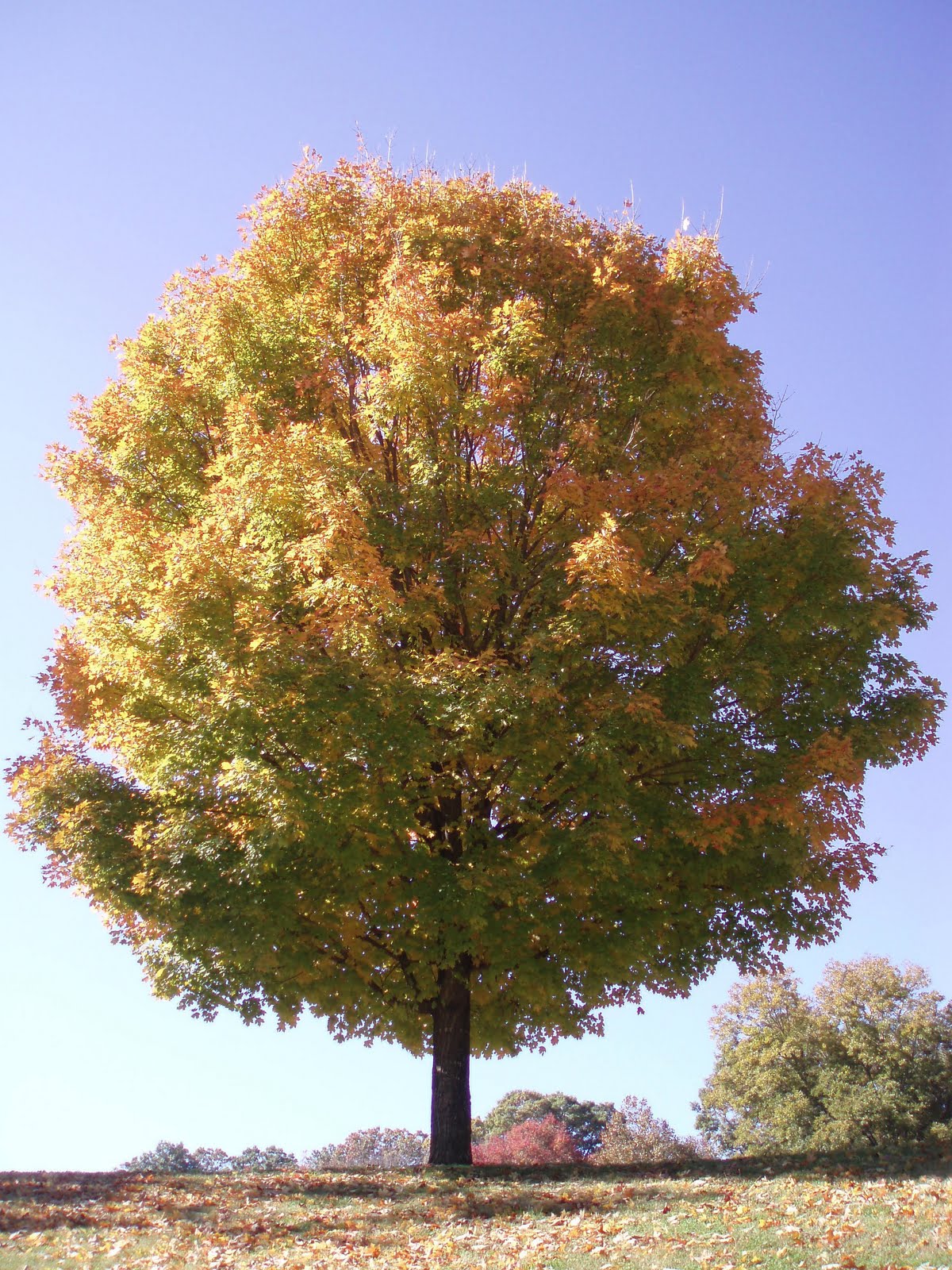
Left: A "pasture" maple at a park near me.
Below: When I take a nature walk, I am often looking up, into the canopy.

Wednesday, March 24, 2010
Ad Absurdum: How Much Do We Hate the Gubmint?

Whatever your thoughts on the healthcare bill passage, you gotta admit it has brought the crazy out in more than a few people. Where is the sanity, indeed?
One wonders how many folks currently on Medicare are protesting "Socialist medicine"?
Via Terrierman's Daily Dose:
(Author unknown)
This morning I was awoken by my alarm clock, powered by electricity generated by the public power monopoly regulated by the US Department of Energy.
I then took a shower in the clean water provided by the municipal water utility.
After that, I turned on the TV to one of the FCC regulated channels to see what the National Weather Service (of NOAA - the National Oceanographic and Atmospheric Administration) determined the weather was going to be like, using satellites designed, built, and launched by NASA, the National Aeronautics and Space Administration.
I watched this while eating a breakfast of US Department of Agriculture inspected food.
At the appropriate time (as regulated by the US Congress and kept accurate by NIST - the National Institute of Standards and Technology - and the US Naval Observatory), I get into my National Highway Traffic Safety Administration-approved automobile and set out to work on the roads built by the local, state, and federal Departments of Transportation, possibly stopping to purchase additional fuel of a quality level determined by the Environmental Protection Agency, using legal tender issued by the Federal Reserve bank.
On the way out the door, I deposit any mail I have to send via the US Postal Service and drop the kids off at public school.
After work, I drive my NHTSA car back home on the DOT roads, to a house which has not burned down in my absence because of the state and local building codes and fire marshal's inspection, and which has not been plundered of all its valuables thanks to the local police department.
I then log on to the Internet (which was developed by the Defense Advanced Research Projects Administration) and post on FreeRepublic.COM and Fox News forums about how SOCIALISM in medicine is BAD because the Government can't do anything right.
 Me, I'm taking a "wait and see" attitude on H.R. 3200. I admit that giving the U.S. government as much access as they would like to our personal information scares me, but I do not plan to panic until I read the thing.
Or maybe I should have just been in this class.
Subscribe to:
Posts (Atom)