Camerado! I give you my hand!

Camerado! I give you my hand!

Allons! The road is before us!

www.poochprofessor.com


Saturday, June 19, 2010

We have met the enemy, and He is Us

The young dog was gaunt, but I knew he’d been fed on a regular basis. Now, in our care, he ate warily but readily, as long as the food was left for him and no one was looking. His eyes darted back and forth, watching everything. He shrank back in his kennel and occasionally we would hear a low growl emanating from him when we came too close. Crouching down and looking over his head was better, but he still wouldn’t readily approach. At one point, I went and sat in the 8X10 run at the far corner, a handful of chicken pieces in my bait bag and a book in the other hand. I would sit and read out loud, and toss chicken in his direction. For the first 15 minutes he ignored it. Growling came and went. I never looked directly at him.

He eventually stuck his slender neck out and snatched some of the pieces hurriedly, fearfully. After a few agonizing minutes he finished the rest, never taking his eyes off me. When I finished the chapter, I stood up very slowly and exited, not looking back. He watched me carefully, but didn’t move a muscle, as I walked away.

After 3 days of this there hadn’t been much change. I was able to loop a leash over his head, and he would walk with me, but it was not a normal walk. He alternated hanging back and forging ahead in an attempt to free himself from the leash. When the door to the outside opened, he bolted through it and stood, shaking, on the other side. I had him out for about 20 minutes, and he never eliminated. I was able to stroke his fur on his side (he started when I touched him, but didn’t move away, so I left my hand there), but I did not try to touch his head. I spoke calmly to him, and watched as he scanned the area hawkishly, his bushy tail tucked between his trembling rear legs. A loud truck went over a bump in the road, and the dog nearly leapt out of his skin.

He looked wolfish, but it was likely German shepherd and some other lanky breeds. Had he been at his correct weight, where ribs could be felt but not seen, he’d have been beautiful. He had what we like to call “human eyes”: dark brown with rimmed irises. His coat was in decent shape, he was neutered, and I knew he’d finished his last round of vaccinations about 6 months ago.

No, Shiloh wasn't some stray we'd picked up on the side of the road.

He was adopted from the shelter as an 8-week-old pup, by a happy couple who had owned dogs before. They were middle class, no kids (yet), and far from ignorant or unprepared--at least as far as shelter personnel knew. There was no reason to believe that this puppy would live anything but a pampered life with them.

But here he was, returned 8 months later, a victim of abuse. Oh, they never laid a hand on him except to pet him (and I know this because they were horrified the shelter staff might assume they had). He was housebroken, but he didn't have much else in the way of "formal training." You might think that's why I considered him abused--refusing to train a social species that hungers for information about how to fit into our world is, well, at the very least disrespectful to dogs--but that really wasn't even on my mind as I sat with him and remembered the wife crying in the Intake waiting room.

"I'm due in 3 months. And I love him--he's very loyal and attached to me--but he is so scared and spooky, and I just can't take any chances with the baby."

Pregnant couples giving up on perfectly good dogs is nothing new in sheltering. It happens a lot, and one can blame them up one side and down the other (I mean, you've known for a while you were gonna have a kid, right?), or even have some compassion towards their predicament, lame as it sometimes sounds, but at that point, it is moot. Cultural traditions, myths, advice from well-meaning people and the glut of information online, coupled with the emotions surrounding the fact that your lives are about to change forever, put seeds of doubt into would-be parents' minds, and often there is no going back.

I didn't fault this woman for the choice she had made. Pregnant couples giving up on perfectly good dogs may not be new, but Shiloh was far from "perfectly good." He was spooky, flighty, and on edge. I couldn't imagine him around a newborn, not to mention all the preparations, and the arrival home from the hospital, and change in schedule, and family in and out after the blessed event. He barely had enough confidence to eat enough to keep his ribs from showing when it was calm and quiet at their home with no visitors or stressful events. A baby in the home would be an accident waiting to happen. I'm childfree by choice, but I know enough to know that nervous, frightened dogs don't mix well with kids, and parents don't usually have a lot of confidence in them--which perpetuates the cycle.

So if they never laid a hand on him or made him go without, how dare I claim "abuse"?

I'll tell you why: he was scared of everything, and not just at first. Shiloh was distrustful even after a period of time had passed with nothing bad happening to him. He couldn't "bounce back" from his fears easily. And while fear has an evolutionary advantage in mammals, an overabundance of fear is not better. It's far worse.

But how is his fear their fault?

Well, the genetics part isn't, at all--they didn't breed him. And though they never laid a mean hand on Shiloh, never yelled or screamed at him, never left him in the cold without food or shelter, never ignored him when they were home with him, and never neglected his veterinary care, they abused him, passively, just the same.

Because Shiloh was never socialized. By their own admission, they kept him inside with them all the time, and during the crucial socialization period that all puppies go through between 3 weeks and 16 weeks of age, when they should be learning positive things about the world, Shiloh was kept from life. They were worried he might catch a disease, so they avoided exposing him to the world. Unknowingly, they took away his ability to develop the capacity to deal with the world outside. Shiloh never went for walks, or on short trips to safe places that wouldn't overwhelm him. He hid in the bedroom when guests came, and he had never seen a child up close. He didn't get to play with other dogs; he didn't attend training classes; he didn't really get to be a dog.

Socialization is inoculation against later fearfulness, and his owners, while meaning well, denied him this vaccination.

And in doing so, they made sure Shiloh would never be normal. Some of his fear was likely hereditary, given his potential breed mix. It was a double whammy, nature and nurture in a negative capacity, and he never saw it coming.

Dogs are social creatures who develop bonds early in life to their own kind and, thanks to years of selective breeding, to humans. It's part of their genetic code to seek a social group, and to seek a place within the hierarchy of that group.

Deny a human child the company of other humans during our formative years (namely, birth to puberty), and the Critical Period Hypothesis says you will get a child that will have lasting damage, including an inability to master language--a result that is not fatal to the child, but certainly increases stress and makes life way more difficult. Puppies go through critical periods of development as well. John Fuller and John Paul Scott, in their landmark study chronicled in Genetics and the Social Behavior of the Dog (1965), said,


Every highly social species of animal which has been studied so far has a short period early in life when primary social relationships are formed…in the case of the puppy, it looks as if a small amount of contact shortly after 3 weeks of age will produce a strong social relationship which can be duplicated only by hours or weeks of patient effort at later periods in life—if, indeed, it can be duplicated at all.

While Fuller and Scott’s study doesn’t say when the “socialization window” closes, other experts agree that it appears to be around 16 weeks of age. Again, it’s a window, so it never completely shuts. But we do know that if puppies are not handled at all by humans before 16 weeks, they will always live in a feral or semi-feral state.

Most puppies get at least some handling between birth and 16 weeks, whether it be purposeful or not. Shiloh certainly had some. But it appears that he—and many others like him, sadly—didn’t get enough. And that’s something puppy breeders, buyers and adopters can change.

Granted, when we compare the undersocialization of human children to the undersocialization of dogs, the latter seems pretty trite. But dogs are everywhere in our society, by our choice, so undersocialization cannot be brushed aside as inconsequential, since it definitely impairs their ability to adapt to our confusing, loud, emotionally-affecting world. And fearful dogs may not want to bite as their first defense, but when cornered, many will.

Refusing to train a dog to understand the rules of our world is refusing to acknowledge the dog's real needs, does nothing to help dogs, and often harms them. It's especially heartbreaking when you know training isn't difficult, time-consuming, or expensive, it need not be harsh at all (it's actually a lot of fun if done correctly).

But forget obedience training for the moment. Not exposing a puppy to what life will hold for him later, even just the basics of people with different skin tones, outfits and different voice tones; loud noises; cars; children; bicycles; and various and sundry things we take for granted every day is abuse. It's setting up for failure a creature that craves anything but social isolation. It seems inocuous, but it isn't. It seems better for the pup to isolate him from possible disease, but it isn't.

The problem with neglecting to socialize a puppy that is hard-wired for it is that once the crucial window closes, experts agree that it is partly closed for good. Yes, it is more than possible to socialize dogs past 16 weeks (it's a window, not a steel door); people do it all the time. But you can't get back all of what you lost. You can help the dog, but something will always be missing: an important piece of the puzzle that is best acquired while the dog's brain is still forming.

My friend Sarah Wilson is an author, teacher, damn good trainer, student of the human-animal bond, and a wise woman. She does her best work with what she calls "deficit dogs": dogs with decent genetics who had a bad start in life, but with the proper training and an owner who looks to the future instead of dwelling on the past, will make progress. Most make incredible progress under her tutelage, and so do the bipeds holding their leashes. (An article from Sarah with ways to help deficit dogs.)

When it's done right, it can be remarkable. The dog may make infintesimal strides forward for so long you think nothing is happening, and then, Bingo! You see a huge success. If you don't push it, more success will follow.

But it's not an easy, or quick road. Socializing and training deficit dogs is a slow process that happens in small fits and starts, and one setback (e.g. thinking the dog is ready for The Big Leagues before he has even started batting practice) like thrusting him into an unwinnable situation, can reverse all the good progress already made. It's maddening for owners and trainers, and sad for the dogs.

Many of these dogs reach a plateau after a while. They hit the ceiling of As Good As It Gets, and they may never get past it. Owners of these dogs must be prepared for that, and all along they've had to be realistic about Fluffy, realizing she'll never be the outgoing Life of the Party they wanted. But that doesn't mean the dogs don't deserve someone who will try. And many people do--because you don't train the dog you wanted to have, you train the dog that you actually have, the one sitting right in front of you, for better or worse.

Shiloh is not a true deficit dog, by my estimation (though time will tell), because he likely has hereditary fear, and no amount of training will overcome genetics. He'll probably always be a bit flighty and nervous, and never really comfortable around men or small children.

When people see his behavior, most immediately assume the abuse he suffered came in the form of a child teasing him, or a man beating him. But in truth, it's because he was never exposed to children, and the only man he knew was the husband, who is short and very soft-spoken. Though there is no way to know, my experience is that what the public wants to see as conditions arising from physical abuse (cringing, submissive urination or defecation, ducking when an arm or object is raised, avoiding eye contact, bolting for safety, or even snapping when cornered) are more often symptoms of a lack of socialization. If your dog hits the dirt every time you pick up a broom, your first instinct is to assume that someone hit him with a broom. While that is certainly possible in dog you have not lived with his whole life, what is more likely is that a broom fell when he ran into it while exploring during his "fear period,"(maybe more than once), or an adult picked up a broom and gently shooed him with it while yelling, and now he thinks brooms are agents of Lucifer. Things learned during the fear periods have lasting consequences, and even if they are not harsh, they can be perceived or "remembered" by the dog that way.

NOTE: I'm not saying that the "guilt" behaviors mentioned above never have roots in actual abuse. It's positively horrific what humans are capable of doing to animals, and shelters in more rural or depressed urban areas see the effects of abuse far too often. But we do know that a lack of socialization also causes timidity to people and objects, and when we know this, we are less likely to spout The Abuse Excuse. When we let that go, we can move forward with the dog.

So what is good socialization? Experts don't always agree on how much puppies need, but most of us agree that many puppies don't get enough. Good breeders (you know, the ones who do health checks and genetic testing to weed out congenital defects, screen buyers carefully, breed for temperament, work with rescues to take dogs back, breed 1 or maybe 2 litters a year, specialize in one or maybe 2 breeds, don't disappear after the sale, don't try to pawn off multiple pups on unsuspecting buyers, and understand genetics and their breed thoroughly) raise pups in the home and generally follow the Rule of Sevens. (Some say that's a good guideline, but may not be enough.) They don't allow pups to leave the litter before 7 weeks at the earliest, and if they keep the pups longer (some up to 12 weeks) they start crate training, housebreaking, and do even more socialization. Good breeders also encourage the new owners to continue the socialization from the day after purchase through 16 weeks and beyond, with suggestions like well-run puppy training classes, and lots of safe visiting in the community.

Dogs born in puppymills generally have little or no socialization because those producers have no interest in the final product, only the money they receive from the transaction. In spite of that, to dogs' credit, some puppymill dogs manage to turn out OK, though that in no way implies that I support anyone going that route for a pup. But if you adopt a purebred or a designer mutt from a shelter, you may be getting a puppymill dog that an unsuspecting pet store shopper could not handle--so be prepared.

It has long been common knowledge to trainers that a lack of early socialization causes problems down the road. A lack of training will cause problems, too, but the "training window" never truly closes, as dogs (like people) are always learning. Many people have adopted adolescent and adult untrained dogs from shelters and turned them into fantastically-trained, outgoing, happy dogs. It takes longer than with a new puppy, but it's more than possible.

Trying to make up for a lack of early socialization, however, is like trying to push string. It takes a lot of patience and time just to get the dog to a place where obedience training can begin. Unfortunately, this is more of a project than the "average adopter" signs up for, and though deficit dogs tend to be very attached to their owners, excessive neediness is not healthy for man or beast.

It is far preferable to set the puppy up for success, so no matter what obstacles he meets later in life, from the stresses of a new baby at home to having to be rehomed, he can acclimate to them. Well-socialized dogs are easier to train and live with, and live less stressful lives.

Shiloh was adopted eventually, by a young man who'd owned GSD before. He and I talked for a long time about the road ahead, and I really think he understood (though it is likely to be longer than he thought). We discussed how to make up for lost time, and how to go slowly, and we discussed the plans he had to make Shiloh's new life better through training and socialization. I told him that Shiloh didn't need his pity--he needed the young man's strength. I told him that his own confidence, plus guidance and structure (i.e., training), would give Shiloh confidence. I told him not to expect miracles, but to shoot for small successes every day. I told him that he couldn't change the past, but he could affect the future--and for Shiloh, a world with less stress and more chances to "be a dog" would be heaven.

Every dog deserves that.

Monday, June 14, 2010

"Uttering joyous leaves of dark green"

All my life I've been fascinated by trees. I grew up in what the U.S.D.A. Forest Service calls the Blue Ridge area of the Central Hardwood region. There are a number of pine trees (considered softwoods) in my yard and in my neighborhood, but luckily, there are quite a few hardwoods, too. Oaks are my favorite, especially Quercus rubra (Northern red oak) and Quercus alba (White oak). In one of my first blog posts, I wrote about my favorite trees, and I alluded to climbing them. 

 My love for trees began early, when I'd spend every nice day outdoors, and often alone, in the woods behind my house. There was quite a bit of undeveloped land in the neighborhood, and I'd explore it happily and safely as often as possible. My friends and I built forts from discarded branches and created walking trails in an area probably only a few acres in size, but it felt gigantic (and private) to us. Neighbors didn't mind us tramping through their "way back" backyards (they certainly never went back there), and if they did, they didn't say. 

"In the woods" was where I started looking up. The trees were magnificent and plentiful, and my friends and I climbed as many as we could, but most in our woods were older and too tall for us to reach the branches. I often wondered what it would be like to perch myself high up in those branches, but I knew I couldn't fly and the idea that it was possible to get there was too wild to fathom. So I surveyed reverently from the ground, and in the meantime passed several phases of childhood in that shady landscape. "In the woods" was where I also had my first kiss (and several subsequent ones, but don't judge me--this was when "making out" was kissing and not much more), my first look at porn (1970's Playboys stashed under what someone must have thought was a hidden rock), typical pre-teen angst and mood swings ("I hate you and I'm running away!"), and many adventures jumping creeks, catching tadpoles and crawfish, and just hanging. I played softball and of course had school, but I never had playdates or structured activities that I can recall. You had to listen for the cowbell to know when Mom was calling you for dinner, and we were discouraged from being in the woods after dark, so our post-prandial play moved to the front yards and the nearly empty neighborhood streets until bedtime.

But the woods were the best. I used to fantasize that my folks would buy me a horse and I would build him a stable in the woods just behind the house ('cause, hey, I could built a rudimentary fort, so surely he could live in something like that, and he'd eat...leaves and sticks?), and I'd ride him through the trees along our trails. When I wasn't trawling the woods, I spent time in our own semi-wild backyard inside the fence. Grass never would grow in our yard, much to my father's consternation, because of the trees. That didn't bother me one bit, and I think he secretly was glad, because he had no intention of cutting them down--and he hated to mow. I climbed the one tree I could reach from the ground, a Southern Magnolia, to my heart's content and found great solace in being in the branches. It was my own special place, and I distinctly remember bolting up it through tears on the day I learned of my grandfather's death in 1977. (One of the first scenes in "Fried Green Tomatoes" always reminds me of that day.) The trees I love most and I grew up together, though they had a long head start. I still live in that house (yes, I moved away for a while, attended college and lived in a few other places--the usual "spreading the wings"), having bought it from my father's estate some 15 years ago. It holds much sentimental value for me, and the trees are a huge part of that. Though I always thought them huge, they are much taller now. And I still cannot fly, but yes, I have been in those topmost branches.

  In 2004, I decided that wings were not necessary to get up into trees, and I sought out treeclimbing. I found Tree Climbers International, and wouldn't you know it, it wasn't 10 minutes from my house. Founded by an arborist named Peter "Treeman" Jenkins, TCI taught recreational tree climbing, and just happened to have a "free climb" once per month. That's where they would set the ropes, help you into your harness and give you a little tutorial, and you'd be up in the branches as quick as you please. Well, if you were 10 and skinny, that is. My overweight, almost-40 self didn't do much quickly those days, so the first climb was a bit of a disappointment. I think I got about 15 feet off the ground. But I was hooked, and I was determined to make it to a branch at some point--first at the TCI grove, and then in my own yard. 

 Luckily for me, TCI offered courses to teach you how to tie the ropes and get yourself up into the canopy. The techniques they use are not harmful to the tree (no spikes), and you can go as high as a few feet below the branch where your line is set. I signed up, and after a pretty grueling 2-day intensive, I was armed with knowledge (and sore muscles--but I passed the course). I purchased my climbing equipment (standard arborists equipment with some slight variations) and set out to set static lines in the trees in my yard. People often ask, when I tell them I climb, "oh, is it like rock climbing?" When I say no, they seem disappointed. Treeclimbing with ropes is not as strenuous as rock climbing, though it can be a decent workout. And the ropes get you both up and down, not just down. It's also a "self-belay" system; you don't need another person on belay, so it can be a solitary activity. We use the same carabiners as rock climbers and cavers, but the chalk, special clothes, and special shoes (some tree climbers do it barefooted) are unneccessary. 

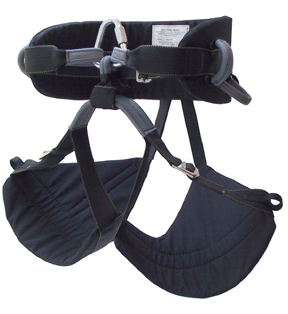
 Tree climbers use arborists' rope, which is different from rock-climbing rope, because it has less "give." You can't leave it in the tree all the time, because it will rot. So if you want to climb repeatedly, you set a static line in the tree in the setting you want, using a thin nylon cord that is impervious to the elements, and you haul your climbing rope up using that line. (I actually use plastic-covered clothesline; it's cheaper than zip line). Otherwise, you have to throw the line (using an arborists' throw bag) every time, and it's a skill I am only slightly good at. I set 4 lines, two each in two trees, the white oak Zemyna in my front yard, and the red oak Hannah in the back. So when I want to climb, it only takes a few moments to get my 1/2" rope into the tree and tie my climbing knots. Then I saddle up in my recreational saddle (the "Tengu" model at right), put on my helmet, hook on a water bottle, camera bag, notebook and gloves, and I go "on rope." I use locking carabiners to secure myself to the rope. 

One of the cardinal rules of tree climbing is that you never unhook from your rope while in the tree. If you obey that rule and tie your knots correctly, it's incredibly safe. The climbing technique I use is called DRT (double rope technique), and it uses a very ingenious knot called a modified Blake's hitch (the topmost knot in the photo at left) to allow the climber to ascend and descend easily. You pull yourself up using your own body weight (upper-body strength is necessary, but you mostly use your legs and your weight). I use a Prussik loop on the rope with my feet in it to literally pull the opposite end of the rope downward, which sends me upward. The Blake's hitch is scooted up by hand, and holds me in position. Eventually, I reach my destination branch, and after hanging out there a while, I decide if I want to switch branches and ascend higher, or descend. 

 Descent is simple and fun. You just grab the Blake's hitch and apply pressure on the top of it, and gravity will do the rest. A safety knot in the rope keeps me from plummeting too quickly, and if I get to going to fast, I just let go--and the knot holds. It's pretty clever. (A single rope technique, or SRT, exists too, but it is mostly used by more experienced climbers and for really, really tall--300 feet and up--trees like redwoods. SRT requires some different equipment and skills, and I never learned how to do it. DRT works fine for my trees, which are 80-100 feet tall.) It usually takes me about an hour from the time I decide to climb to when I'm on my destination branch. I usually go to a branch about 45-50 feet off the ground when I climb Hannah. Zemyna has more copious branches and a tighter canopy; when I climb her, you have to look hard for me in the summertime. (Can you see me ->?) 

 And what happens when I get there? Nothing. Blissful, quiet, cool...nothing. Being in the tree is indescribable, especially in the fall when the breezes are spectacular and the sky is so blue it almost makes you cry to look at it. You hear leaves rustling and the sound of your own breathing, birds chirping, and the creak of the branches. You can see your neighbors mowing their lawns or strolling by, and they can't see you (because they don't look). I admit that I like to call my dog and see how she'll react; she's not the brightest bulb in the chandelier, so she usually looks for me for quite a while before forgetting I exist (until I come down, and she has this relieved and puzzled expression I take to mean, "I thought I heard you calling me!"). Dusk is lovely, and climbing at night is even more thrilling. I haven't yet slept in the tree, though several companies make hammock-type apparati for doing just that. I'd like to put a semi-permanent pallet in Hannah, if I can figure out a way to do it without harming her. I have a Sky Chair that I will haul up and clip into a setting placed just for it. It's a great place to read or write or just think, which I do a lot of.
"Murmuring out of its myriad leaves, Down from its lofty top rising two hundred feet high, Out of its stalwart trunk and limbs, out of its foot-thick bark, That chant of the seasons and time, chant not of the past only, but the future." ~Walt Whitman, from Song of the Redwood Tree


Wednesday, May 26, 2010

I think I'm going to be Sick

Sorry for the cop-out, but I had to cross-post this.

This bit of WTF from Raised by Wolves has just about ruined my day.

It's bad enough that the cruelty is perpetuated, but the outrage is over what happened next.

Nothing.

The pictures are graphic. There are only three, but that's all that is needed. Be forewarned. The second and third ones are heartbreaking.

I have had more than one person who bought a dog from a pet store tell me s/he was told it came from "a reputable breeder." Well, if in their world "reputable" means vile, shameless, heartless and only in it for the money.

Since I tend toward the positive, especially when it comes to doggy stuff, you may ask why I posted this.

It wasn't to upset anyone. It's not gratuitous. It's to educate.

Thursday, May 13, 2010

"Don't Blame the Dog!"

A while back, I wrote a post about shelters and rescue groups not wanting to see the forest for the trees, and therefore were unwilling to properly screen dogs up for adoption, euthanize aggressive dogs, or admit that what they were doing was unethical, and bad for dogs.

I've been in a back-and-forth on an email list about this very subject the last few days, and it made me think of some more things to add to my diatribe.

Why are we not allowed to blame the dog, again? When dogs bite, and especially when they bite aggressively, with purpose to maim or worse, it is ALWAYS because the owners "did something wrong"?


They didn't socialize the dog when he was a puppy. They didn't train him. They overtrained him. They trained him too harshly. They trained him too wimpily. They used the wrong type of treat/training collar/leash/attitude. They fed him food with too much protein. They fed him from a stainless steel bowl, when they should have used plastic. They fed him from a plastic bowl. They fed him too much/too little/too often/not often enough. He was hungry. He was itchy. His feet hurt.

They crated him too much. They didn't crate enough. They let their kids tease him. They didn't let their kids interact with him enough to make him understand the kids were "in charge." They should never have gotten a dog because they had kids. Didn't they know Fido doesn't like kids?

The people worked too much, and were gone all the time. They didn't work enough, and were home all the time. They petted the dog too much. They didn't pet him enough. They paid too much attention to him. They didn't pay any attention to him. They tied him up. They didn't tie him up.

They named him a silly name. They didn't take him to the vet. They neutered him too early/too late/not at all. He wasn't vaccinated. He was over-vaccinated. They fed him Ol' Roy. They fed him top-of-the-line food, but it was crap because it wasn't raw food. They fed him raw food when he should have been eating kibble.

They dared to walk into the kitchen one day, nowhere near the dog's food bowl or toys, or the actual dog, and the dog launched himself across the floor and leapt up and went for the face of the teenage girl, and latched on, shaking back and forth, knocking her backward, and would not release despite her father beating him with a chair. He would not release until the hold on his collar made it hard for him to breathe, and he opened his mouth to get more air, and he was propelled backward. After the father shoved him across the kitchen and bent over his daughter--who had never done anything to the dog but interact normally with him--to try to stop the bleeding from the gash, the dog came back for more and the father had to cover his bleeding daughter's body and take several slashing bites to the back and arms before someone mercifully leashed the dog and threw him in his crate.

I KNEW I had left out something from the previous list of wrongs committed by this stupid, clueless, never-should-have-owned a dog family: walking into the kitchen!!

People are so dumb, right? How dare that girl walk into her own kitchen. She should have known better.

My brilliant, inspiring, and astute friend Sarah Wilson is, among other things, an author, trainer, teacher, lecturer, student of the human/animal bond, and wise sage when it comes to dogs and people. Her definition for serious aggression is the most succinct way I've ever come across to express it.

"When normal life events cause offensive aggression with little or no warning, that dog is not a pet." ~Sarah Wilson


So, when a dog bites without warning over normal life events, whose fault is it?

It's not an easy question to answer, but I will not lay blame at the feet of the teenage girl walking into the kitchen.

Perhaps the family was inconsistent with this dog, and he was truly confused as to who was the leader in the home. Perhaps he absolutely believed he was ruler, and she had no right to cross "his" property without permission. Perhaps any number of things from the above laundry list of "sins" dog trainers often bemoan were happening in the house.

Maybe he had a brain tumor, or some other medical issue that contributed to his vicious, unprovoked attack. If they had just taken him to the vet and had a full blood workup done, the vet might have found something. Neurological disease? Cancer? Thyroid imbalance? These can all contribute to aggression.

And perhaps, just perhaps, the dog was genetically wired wrong. Maybe it's the breeder's fault? Mother Nature? Zeus? Charles Darwin?

Does the picture above make you think, "Awww! How sweet!" or does it make you cringe?

A popular book amongst a subset of dog trainers (those who call themselves "positive" or "all positive") is Karen Pryor's Don't Shoot the Dog! Originally published in 1984 (I believe), it is a slim volume from a dolphin trainer-turned-dog-trainer that points out some of the misconceptions about dogs and behavior. It was the first book I remember reading that specifically exhorted dog owners to blame themselves for their dog's issues, not the dog. Other authors have done this, too--and for good reason. Most of our dogs' behavioral "problems" are indeed our fault. We are lousy communicators with species other than our own (and not even so great with our own, right?)

We get frustrated and angry at our dogs over things we should have trained them not to do. Dogs do not have morals or ethics, they simply have behaviors. Some of those are acceptable to us, and some are not. Training is about instilling the behaviors we want and teaching the dog to abstain from the behaviors we do not like. Since many of these "bad" behaviors are normal for dogs, it can be challenging sometimes.

Certainly, we cannot expect the dog to learn our language--we must learn his, and speak it to him.

When we fail to do this, problems can result, aggression among them.

So we must hang our heads in shame as a species for our arrogance at thinking the dog "knew better." After we flog ourselves, we need to get on with the business of being better communicators with our dogs. Modern dog training is about building relationships based on trust, and it allows humans and dogs to coexist quite peacefully the vast majority of the time.

But training cannot override everything. It cannot trump DNA or disease. When it squares off with genetics or medical issues, training by itself often does not come out victorious.

That is why blaming the dog is sometimes necessary, and when serious aggression is on the table, the dog must often pay with his life.

I know what it feels like to love a dog or two. And I know what it feels like to grow attached to dogs one does not own. I have been in the animal sheltering world for more than 10 years now, and working with animals for almost 30 years. I've loved and been attached to many dogs in my life.

I know what it is like to have to euthanize a dog I love who is no longer safe. The pain and heartache is overwhelming. Euthanasia of a beloved animal is never easy, but when the animal is in obvious pain, or simply no longer has a quality of life, at least we can clearly see the need to humanely end that life (and so can everyone else).

Euthanasia of aggressive animals is less clear-cut, so much so that I've had clients tell me their own trusted vet would not do perform the procedure on their dog after its aggression had reached unsafe levels. To the vet, the dog looked healthy. But the vet didn't have to live with what the dog had become. He or she did not have to walk around on eggshells in his or her own home because the family pet could "go off" at any given moment. Vets, like doctors, are taught to do everything possible to save lives, not destroy them.

Is the pain of euthanasia worse when one is made to feel guilty for it?

How do you think it feels to the family of the dog who attacked the teenage girl to be told by their vet that euthanasia is not appropriate for this dog, that they must have done something to provoke the dog, and that putting this dog down would not be fair to the dog? Perhaps the maimed young woman should be the one to, oh, I don't know, maybe take the "healthy" dog to an obedience class after she heals and get him the training he never got. Her scar(let letter)s could be an abject lesson for all to see: see what a lack of training gets you?

Until one has lived with a truly aggressive dog, has lived with the fear that the dog might hurt a family member or a friend or a stranger, or might escape the yard and maul a child, it is hard to imagine what it feels like. It's something that keeps decent people awake at night.

And from the often-grim insides of a rescue or shelter, teeming with unwanted animals that have, through no fault of their own, been cast off, treated poorly, abused, or simply neglected, the thought that the dog deserves another chance is not as uncommon as you would think.

After all, it's not his fault, right?

When it comes down to it, a homeless dog with a known bite history is a huge liability for anyone with which it has contact. Good shelters and rescue groups know this, and will not put up for adoption animals with known bite histories.

(NOTE: ANY dog with a bite history is a liability. But my main beef is with groups housing and adopting out homeless aggressive dogs, NOT owners who have such a dog and are trying to manage the situation while keeping the dog. That is still an issue, one based on personal choice that should never be taken lightly, but there is a difference.)

Fault is not the issue here--knowledge is. And knowledge can be a painful thing.

Good shelters understand that people deserve better than a pat, facile, "It's not his fault."

Some shelters and rescues who ignore this dictum and believe all dogs are salvageable claim to give "full disclosure" to adopters about the dog's history. They say that "some people want to adopt these damaged dogs, so we should let them." They think that disclosure will shield them from a lawsuit, but it won't.

And it wouldn't matter if it did. If the known biter bites again, more lives will be changed forever. The damage will be done.

Is it POSSIBLE to adopt out known biters and have them managed safely so that they never bite again? I suppose it could be. Is it ethical? I do not believe so. Is it kind? No. Are most adopters equipped to deal with this sort of dog for the rest of its life? No. Should they have to? No.

Some of these "rescuers" decide that Fierce Fido isn't safe for the average Joe, but he would be fine for a dog trainer to adopt and work with. How many of us do you think there are walking into shelters on a regular basis, looking for such a liability-er, project? Very few--we already have multiple dogs.

Doing something unethical and quite possibly dangerous "because some people want to" is not a recipe for a successful enterprise. And, here's a shocker--MOST people do NOT want it. They don't want to own an aggressive dog, they don't want to live next to an aggressive dog, and they don't want aggressive dogs in their neighborhoods.

So these "save 'em all" rescue groups are endangering the majority to make themselves (and the mysterious "people who want to") feel better. Since it's never the dog's fault, they think what they are doing is humane. But what they are really doing is eroding the rights of dog owners, little by little. They are creating a culture of fear with dogs, so that children are growing up afraid of dogs--a fate that should not be visited on anyone, much less a child. These groups are turning people away from adoption (or dog ownership in general) in tiny little increments, which affects all animals in shelters. It has been said that only 10% of the animals in people's homes came from shelters. Do we want that number to decrease even more?

(And that leads us down another slippery path towards the "Abuse Excuse" and its ramifications.)

The truth is that some dogs are just not pet material. And until shelters and rescues get their emotions pushed aside for just a minute and realize how their inaction with aggressive dogs ripples out community-wide in mostly negative ways, they will continue to blame the owners, the breeders, the pet store proprietor, the puppymiller, and Jesus, Joseph and Mary for the dog's aggression.

It may not usually be the dog's fault, but it is all our problem.

Wednesday, May 5, 2010

Reciprocity

From someone named Ben, on a blog I frequent:

This also reminds me of a similar revelation I had a while back: a person who says “no, thank you, I’m fine” all the time makes for a lousy guest. The dance of giving and receiving is what brings us together, and “being no bother” is actually just a recipe for estrangement.


I must be a lousy guest. And I never knew.

I generally refuse offers of things out of a sense of duty: thou shalt not maketh they host wait on thee hand and foot. I feel like I'm imposing if I actually accept something being offered to me upon arrival at someone's home.

Host says, "Can I get you anything? A stiff drink? Soda? Water?"
Me, completely parched to the bone, croaks, "No, thanks. I drank some three days ago," and then I collapse from dehydration.

Seriously, I was taught to refuse offers (and I will not be swayed by Mafioso) because one didn't want to be any bother. I was also taught to say "Yes, Sir" and "No, Ma'am," which I still do to this day, though the line is blurring as to whom it is appropriate to say that, now that I am "of a certain age." And in the spirit of "Bless your heart" (which I could never bring myself to adopt), I learned to say "Wow, that's interesting" when what I was really thinking was, "You gotta be freaking kidding me!"

I guess I never considered that it was rude to not accept. Of course, I knew that some hosts insist until you give in, and what can you do when that happens? Not much. They win. Drink up, Sweetheart.

I actually have a philosophy about it now, especially if what is being offered is of great value. Politely refuse once, and thank them. When it is offered again, politely refuse again. You need to be serious, not coy. You are turning the offer down because It's Too Much.

If they go away, and after long enough to have considered it (like days, not minutes), offer a third time, then jump on that train, Sister! If I give you 2 full, honest refusals, and you offer again, then I very well might accept. So...if you want me to have something, you may have to wear me down.

But how about the ones who only offer once? Or maybe offer again a little later? Isn't it possible they are secretly hoping you'll be polite and refuse them?

If so, don't offer it to me more than twice.

What about you?

Saturday, May 1, 2010

The Best Gift You'll Ever Give


I'm sure no one who enjoys the company of dogs will find this surprising.

Many people would prefer to have conversations with their dogs than with their spouses.

It's not because dogs are wittier, have a greater grasp of the language, or will answer thorny philosophical questions.

It's because they listen. Or, we think they listen. Regardless, they give off the appearance of rapt attention, and as humorist Dave Barry says, "You can say any fool thing to a dog, and the dog will give you this look that says, 'My God, you're right! I never would've thought of that!'"

That's why we like to talk to dogs. (Though I confess I talk to my dogs not because I think they listen to my ramblings, but because I amuse myself by talking to them. I also talk to myself a lot, so there you go.) I'm sure people have other reasons, too.

"The dog is a yes-animal. Very popular with those who cannot afford a yes-man." ~Robertson Davies


But this story brings up a better question for me. Why don't we humans listen better to our loved ones? Many of us pay rapt attention to inconsequential stuff: pop music lyrics, TV shows, sports statistics, snippets about celebrities. Some of us also pay attention to teachers, and other sources of education. What one chooses to pay attention to depends on what one values. It also depends on what one hears frequently, or less frequently. It's easy to "tune out" conversations with our loved ones because they seem to become repetitive, or we find them mundane.

Unfortunately,
"tuning out" those we care about--those we should be listening to--sends a message we probably do not want to send. It says to those people that we don't care, or that we have better things to do.

This is hurtful and depressing, and it definitely doesn't help our relationships. Becoming a better listener can change your relationships immensely, and improve your life.

Try this experiment.

The next time your partner, husband, wife, sibling, parent, lover, girlfriend, boyfriend, your child, or a trusted friend asks (or just begins) to speak with you, do the following.

Put down everything your hands are busy with. This means your computer, phone, coffee cup, paper, pen, Wii controller, whatever. Stop touching it. If it is going to tempt you, put it away.

If the person is sitting, you should sit across from them. If they are standing, you should stand across from them, or invite them to sit.

Face the person, and put your empty hands on the table, or on your lap, loosely clasped. If you are standing, they should be at your sides loosely. Do NOT put them in your pockets, or hide them in any way. Do NOT cross your arms in front of your chest.

Your hands should be visible, empty, and still.

Stand or sit comfortably, back straight, but not rigid. You should be comfortable, but not slouchy. Face the person directly, and look them in the eyes, warmly.

Now, here's the tricky part.

LET. THEM. SPEAK. Do not interrupt. Keep your expression relaxed, but attentive.

LISTEN FULLY. You may not know how to do this, because if you are like most people, you have lost the ability to do it. It's like a muscle--you use it, or you lose it.

You can get it back. Starting now.

Wipe your mind clear--as much as possible--of all thoughts that do not pertain to what the speaker is saying. Do not think about work, or to-do lists, gossip, or what is happening later that day. Ignore your worries. Do not daydream.

Do not think of questions to ask the speaker when s/he is finished. Do not think of what you will say in reply to his or her statements.

Just pay attention, and listen.

Pay attention to the speaker as if your life depends upon absorbing what s/he is saying. No matter how mundane the topic seems (or actually is), your job right then is to hear it, and hear it fully.

When the speaker has finished their thought, or story, you can do one of two things.

If you are pressed for time, smile, and say "thank you" with genuine warmth, then go about the rest of your day. Your experiment is finished.

If you are not pressed for time (and really, can you not make a little bit of time for this?), do the following.

When s/he finishes speaking, count slowly to 5 (to yourself, silly). There should be a marked pause here. Smile. If the end of their speech did not contain a question you need to answer, lean forward just a little, continuing to look them warmly in the eye, and say, "Tell me more."

I don't care how silly, dumb, old, tired, or ridiculous the topic was. Ask them to tell you more. It wasn't silly, dumb, old, tired, or ridiculous to them.

This is someone you love. Someone who gave birth to you, or fathered you, or to whom you gave birth, or fathered, or you have known a long time, or with whom you are intimate. This is someone who knows you, and loves you. This is someone you cherish. This is someone important, someone without which you would not be the person you are right now. This person matters. And what they think, and say, also matters.

Doesn't it?

This exercise is simple to do. It doesn't take hardly any extra time. And you know what? It changes things. When you make the conscious choice to start listening, really listening, to your loved ones, your life will change, and so will theirs.

You don't have to do this with every person you talk to. Reserve it for loved ones who need to tell a story, or convey information. Do it once, and see if you don't want to do it more often.

Extra Credit: the teacher in me wants to give you a chance to excel. So here are 2 things that will put the cherry and whipped topping on this exercise.

1. When the above exchange is over, and you are alone again, get a pen and a notebook or sheet of paper and write down what transpired. You can write a synopsis of the conversation, or just how it made you feel. You can make notes of how it seemed to affect the speaker (if you noticed at all). You can write that it frustrated you, or bored you, or made you think. You don't have to be Tolstoy; no one will read this but you (and your heirs after you are dead--ha ha). Just write it down.

2. About 5-7 days later, approach the speaker with purpose, and ask them about the story. You might say something like, "That incident you told me about with your boss...how did that turn out?" Or, "have you made up your mind about college yet?" Or, "I was wondering if you were feeling better since our talk about Joe's illness, and how it was affecting you." Inquire about it because you want to know, and because you remember the conversation. And listen to their reply, just like you listened the first time.

"Excellence is not an act, but a habit. We are, therefore, what we repeatedly do." ~Aristotle


More on this topic to come. Let me know how the experiment goes for you.

Monday, April 26, 2010

Roll the Bones

I remember being about 9 years old and accompanying my mom to the local Ben Franklin "Five and Dime" store. I believe the company is gone now (though a few stores may still exist in small towns by that name), but younger and more urbanly hip readers are familiar with the concept of the "dollar" store, now seen almost everywhere.

It's not the same. Maybe I have a selective memory, but today's "dollar" stores seem riddled with cheap depressing crap no one really wants (including the manufacturer), while variety stores from my youth had cheap crap a lot of people actually wanted, and used.

The Ben Franklin at our local strip mall was one of my very favorite places to go. I remember buying those balsa wood airplanes every summer, and I still have a fondness for their incredibly simple, rubber-band propellor technology today. And the store itself wasn't large, but it was dark and cool, and Mom would let me wander to decide what trinket I needed to have that very minute. Meanwhile, she bought sewing notions, a hook-and-eye loop for the screen door, a turkey lifter, and a plunger. Was there something the store didn't have? It seemed to my child's imagination that Ben Franklin had tons of stuff.

But not as much stuff as one can find at most every store today. And therein lies the problem. We simply have too many choices. And having too many choices can leave us overwhelmed and anxious.

I wish I could explain this as well as Cath Duncan does in this blog post. But I can't. So go read it, and come back. Because it relates to choosing a pet.

How having too many choices relates to pet acquisition

To paraphrase Cath's post, we use our left-brain to weigh the pros and cons of daily choices, and this works well for us, unless there are too many choices. Then, we start second-guessing our choices, which actually, according to Dan Gilbert, reduces our happiness. It seems weird, but from a personal standpoint, I can totally relate.

And it can affect all parts of our lives, even down to the pet we choose in an animal shelter. Oddly, I had always thought this was because of our pesky emotions, which definitely play a part in our decisions when it comes to animals. But Cath points out that using our emotions can help when there are too many choices. I don't have hard scientific evidence to prove my hypothesis, but when the shelter at which I work is at full capacity for adult dogs, adoptions plateau, then start falling off. Price or perceived value becomes moot (because many shelters lower prices when this happens, in an attempt to "move the merchandise"), and many "lookers" actually leave having truly only looked.

If you asked people as they were leaving why they didn't adopt a pet today, "you had too many to choose from" would not be their answer. I suspect it's unconscious, actually. They felt overwhelmed, but they don't really know why.

When a number of cages are left empty, adoptions increase. There are other factors that play into it, too: weather, the economy, time of year, how many black dogs are in the shelter, and the animals' behavior, to name a few. How clean the place is also affects adoptions, and the more dogs that reside there, the harder it is for staff to keep the shelter clean.

Overall, it does seem to hold true that too many choices of potential pets will stymie the "average" adopter. It's bad enough when you are looking at cans of tomato sauce, or brands of toilet paper, but when you throw homeless pets into the choice pools, people's already frazzled emotions take a huge hit.

(I will explore this emotional link regarding shelters in a future post. I've got lots of theories about it.)

It is often said that life was easier "back in the day" (an idea that minorities would vehemently disagree with), in part because there weren't more than a couple of choices we faced every day. I can see how this might have been true. From brands of products to how to live our lives, not having to analyze everything must have been a relief.

Technology has improved our lives immensely, but at what price? If adoptions decrease when one has too many dogs to pick from, then dogs stay in the shelter longer, which increases the chances that stress will degrade their behavior and health--even in the best-run facilities.

That doesn't mean adopters should make uninformed choices, but the opposite of that is not making a choice at all. And Neil Peart very brillantly had something to say about that.

Wednesday, April 14, 2010

Embarking on the Obedience Train

Would you agree that stability and clear communication in relationships lead to their success? Then you should agree that trained dogs are happier than untrained dogs. Trained dogs’ lives are more stable and consistent, and they are rarely sent to shelters for behavioral problems. They are part of the family, rather than relegated to a boring backyard or crated most of the time. Since training your dog is so essential, one wonders why anyone would want to have an untrained pooch!

The sad fact is that many people are more willing to give up their dog instead of putting effort into training. Perhaps they are put off by the cost or effort required (often, the perceived cost or effort is greater than the actual cost and effort), or they simply think their dog doesn’t need manners. Whatever the reason, untrained dogs are suffering because of it. Finding a trainer who will work with you and your pooch effectively isn’t difficult, but it is essential to know what you need and where to look. Refusing to train the dog is simply not an option–-if one day you can’t live with him because of his behavior, why expect someone else to?

To canine professionals, training is not a luxury. It's a necessity. We have brought dogs into our lives on purpose, and there is no doubt that they have enriched the human race in immeasurable ways. When you realize that enriching their lives by simply showing them the proper way to behave in our lives takes so little time and effort, you will wonder why you didn't do it sooner. Training provides stability and purpose for dogs, many of whom are no longer performing the jobs that they were originally bred to do. It also gives them freedom.

As for what the "right" way to train is, there is one maxim to remember: no tool or method works for every dog. Dogs and their owners are individuals working as a team, and what works for one “team” may not work for another. It may take some trial and error to find just the right tools and methods, but once you do, your dog will thank you for it, and your relationship will be much enhanced.

All dogs need a leader and a set of rules to follow in order to fit well into the household. A competent trainer will be able to match your needs and the dog’s needs to tools and methods that work best for you. He or she will also be friendly, helpful, accessible, and care about what you need and want, in addition to making sure you are meeting your dog's actual needs. Training should be interesting and enjoyable for both you and the dog. Your dog should improve after just a few sessions, and you doing your homework.

Here are some pros and cons of the four basic training setups.

Do-it-yourself

Pros:
1. If it works for you, it's cheapest; minimal money outlay is mostly for books/video and training tools
2. You are building the relationship with the dog; dog learns to work for you
3. It can be done at your convenience in the place of your choice and at your pace

Cons:
1. The method you choose may not work for your dog; books and manuals vary widely in approach and cannot always answer your questions
2. No professional is on hand to make sure you are doing right by the dog and the dog is actually learning what he is supposed to be learning (no feedback)
3. No professionally-supervised socialization or distractions

Classes

Pros
1. Typically it's the least expensive of professional help options
2. Shows you how to teach your own dog; dog learns to work for you
3. The better ones contain a beneficial socialization component, and the added distractions of class prepare the dog for “real life” situations
4. You get to meet and speak with folks “in the same boat” as you–-you learn you are not alone, and you can meet some fellow dog-lovers
5. Allows for lots of training opportunities, including doggy sports like agility and flyball

Cons
1. The method they teach may not work for your team; instructors can vary widely in approach and teaching skills, and may forbid certain tools or methods that could work for you
2. Little individualized instruction; multiple class attendees means less attention per team
3. Not suitable for aggressive animals and won’t always work for major problem behaviors
4. Scheduling and geography may not jell with your needs

Private lessons (usually held in your home)

Pros:
1. Individualized instruction is tailored to your dog’s (and your) needs
2. The dog learns to work for you with the aid of professional help
3. It can be done usually at your convenience in your home and at your pace
4. Problem behaviors have best chance of being solved

Cons:
1. The method the trainer uses may not work for your dog or you (though a quality trainer will figure out the best way to get results)
2. One of the more expensive training options, and once you've paid for it, you may feel obligated to keep using the trainer even if it isn't working
3. It has less chances for socialization than classes
4. Regular “home” distractions (phones, kids, etc.) may lessen your chance of success

Board-and-train (B&T)

Pros:
1. Provides individualized instruction tailored to your dog’s needs
2. Your dog gets the basic foundation from a professional, away from the distractions of your home
3. Great for dogs that need to be boarded during the time they should be getting trained (i.e., crucial learning periods)
4. Most of the "startup" work is done for you

Cons:
1. It can be expensive
2. Dog is learning to work for the trainer, not you; you may not get good follow-up once the boarding has ended and find that the dog doesn’t behave at home
3. Most of the work is done for you, so your relationship with your dog is not growing
4. You cannot watch how your pet is handled or trained or socialized

When choosing trainers, ask questions! A quality trainer is one who is experienced, knowledgeable, makes you feel comfortable, likes your dog, is flexible and willing to use the tools or methods that work best for your dog and you, and who gets the job done to your satisfaction. After all, YOU have to live with the dog.


Word-of-mouth referrals are the best way to find a good trainer. Ask for references, length of experience, and what types of dogs and behaviors they've dealt with. Avoid a "high-pressure" tactic to get you to sign up, and avoid franchises with "too-good-to-be-true" guarantees. These often mask a lack of experience, and can inflate the training's price--and may do you absolutely no good. Caveat emptor.

P.S. Remember to take what you see on TV in regards to dog training with a grain of salt. Some of it works, some of it is just for show, some of it isn't even training. Plus, you don't know what ended up on the cutting-room floor. Though TV would like us to think differently, problems are never solved in one hour or less.

Training takes patience and time. Good training is efficient, but it cannot be rushed. Your dog has had weeks, months, or even years to build up his habits. It may take some time to erase them, and replace them with better ones.

If you don't have the patience for this, you should have gotten a cat. Or a guinea pig. Or a hamster. Or a fish. I'm just sayin'.

Monday, April 5, 2010

Why I love Max and Maira


"I want to say
That wonderful ideas
Can come fom anywhere.
Sometimes you make a mistake,
or break something,
or lose a hat,
and the next thing you know,
you get a great idea."

~Max Stravinsky


Max is a poet, and a dreamer. He is also a dog.

Max is the hero of several children's books by the witty and wonderful Maira Kalman, whose drawings have appeared on the cover of the New Yorker for years, and hilariously decorate the pages of The Elements of Style (apparently, she went into a store one day, picked up a copy of the book, and decided that it needed pictures), as well as non-Max books and several lovely year-long blog projects for the New York Times (I am so hoping she will revive her blogging). The most recent is "The Pursuit of Happiness," from 2009. It will be released as a book this year.

Max is the dog everyone wishes they could be. That's why I love him.

"Good things come out of incomprehension." ~from "Illustrated Woman" TED video, October, 2007

Maira doesn't believe in talking down to kids. I don't have children, can't have them, and have never wanted them, but the fact that she doesn't talk down to them gives me hope. Most kids are way smarter than given credit for. Many parents think they have to "dumb things down" for their kids, but I find that to be tiresome and pedantic. I think children should be exposed to things that make no sense to them yet. I think it widens their brains. Like puppies, they are sponges, soaking up the world in little bits and bytes. You never know what will stick.

(That said, my never-to-be-born children would have grown tired of me, always offering them art and literature that was too advanced for them, and expecting them to like it. "Just because you loved Romeo and Juliet when you were 11 and practically memorized the whole play doesn't mean we have to. I wanna play Pokemon!" I would then grumble and sigh and say something like, "When I was your age..." and they'd tune me out. So, better to be sans children--I'm sure their taste in art would have bored me.)

Readers understand the incredible power of literature, and I do believe that kids reading a bit over their heads makes them better readers, and enjoyers of the printed page. Kalman's "Max" stories are poetic and use words most kids (and many adults, albeit typically not the ones reading her work) don't hear on a daily basis--words like pluperfect, ruminations, and debonnaire. Her character's names are delicious. (I so hope one day to meet a Mr. Hoogenschmidt.) One has the lovely moniker Ferrrnando Extra Debonnaire....great name for a dog.

Speaking about the seminal writer's style manual for the ages, Strunk and White's The Elements of Style, she muses,
"E.B. White wrote a number of rules which can either paralyze you and make you loathe him for the rest of time, or, you can ignore them, which I do, or you can, I don't know what--eat a sandwich."

Kalman's text in her kid's books scrolls wildly on the pages, too, which has a certain "to hell with you, typesetter" quality to it. It wraps dangerously around her drawings, clinging to them precariously on some pages. I LOVE THIS. It satisfies me like a nice rare steak at the end of an emotionally trying day.

You know what else I love about Maira? She takes photos of oddities, or everyday objects, and then draws pictures of them and thinks up captions. I can't paint, but I do like oddities, or the art of the absurd.

She uses words purposefully, and yet, with abandon. If I was ever able to meet her I would surely babble like a schoolgirl and bow down like a subject humbled before the crown. I'm embarrassed just considering the thought.

If you haven't seen her work, you are missing out. Besides the Max adventures (including my favorite, Swami on Rye: Max in India), check out Smartypants: Pete in School and Sayonara, Mrs. Kackleman. The Principles of Uncertainty is a classic.

.(above) From "The Pursuit of Happiness" blog.


Kalman's bibliography on Amazon

Definitely worth a watch: Maira Kalman, the illustrated woman | Video on TED.com

Saturday, April 3, 2010

Rescue Remedy


"Better to light a candle for one lost dog than to curse the darkness of man's indifference. Saving just one dog won't change the world, but it surely will change the world for that one dog." - Richard C. Call

Given the vast numbers of homeless dogs in this country, one understands why there are countless groups who are trying to help them. There are thousands of shelters or rescue groups in this country (no one knows how many for sure, as there is no agency that unites them all--despite the Humane Society of the United States' ploy to make their donors think there is). Some operate shelters, others do not. Some set up shop at local pet stores and other venues in an attempt to place dogs. Most utilize foster homes and large networks of volunteers to do, ostensibly, what’s best for dogs.

But sometimes, people look past the forest and see only the trees. Not all rescues or adoptive agencies are the same. Some are great places to get a “recycled” dog, and others should never be handling animals at all. This latter group includes shelters or rescues who do not put an emphasis on temperament, and therefore adopt out (or keep caged for life) known aggressive animals in an attempt to “save them all”; who do little or no screening of adopters, or are too strict and unyielding in their screening of adopters; who do not understand how to run nonprofit organizations, and therefore waste money and time; and who are “all about the dogs” while treating most people with suspicion or utter contempt.


A friend of mine was once refused adoption of a dog that would have been perfect for her because--I am not making this up--she “might decide to get pregnant one day and have kids,” and the dog was distrustful of children. My friend is not even in a relationship, and has no intentions of having kids—now, or ever. But the “rescue group” was adamant. Apparently, the fact that she has ovaries and a uterus was enough reason to deny her (silly women...always changing their minds, and stuff).

This is utterly ridiculous, and my friend is not alone. I have heard stories like hers numerous times. “Perfect homes” simply do not exist. When you are dealing in a commodity (dogs) that is utterly expendable in many people’s eyes, and you have a surplus of these animals who are dying everyday for lack of homes, you can be choosy to an extent, but being overly picky and unrealistic costs animals their lives.

Spending precious resources on dogs who will not be acceptable pets in most homes is also killing nice, adoptable dogs. Adopters are not usually professional dog trainers. They do not want a “project.” They want a pet! They want a dog they can touch, and train, and have around their kids and their kids’ friends, and make part of their family. In an attempt to “do right by the dogs,” many adoptive groups simply do not get this. Every time an aggressive dog is adopted out, all dogs in rescue and in shelters suffer the consequences. The adopter has a bad experience, and that bad experience leaches into the community like toxic waste into the water table. It is unethical to pass marginal or known aggressive dogs into the community by way of adoption. This is really also true for terrified or extremely shut-down dogs who will never be comfortable in their own skin, for they can become aggressive quite easily. Even if they never bite a single soul, seriously flawed dogs will try the patience of even the most stouthearted of kindhearted adopters. Most people, after 10-15 years spent with a seriously flawed animal that is supposed to be a pet but is instead a frightened, antisocial, unable-to-be-boarded-or-medicated dog will not make the mistake of adopting a "used" pet ever again.

Frankly, you can't blame them. But countless holier-than-thou types in the animal welfare business do just that every day. It's called "blaming the victim."

It’s time for “rescue” groups and other animal adoption agencies to wake up and smell the coffee. This “business” is as much about your potential adopters (the humans) as it is about the dogs. If you are not a “people person,” you don’t belong in animal rescue. If you are too emotional to understand that some dogs will not ever be good pets, you do not belong in animal rescue. If you think that your actions do not affect other dogs in rescue, you are wrong.

It has been said that only about 10% of animals in homes are from shelters or rescue. If rescue groups want to increase this number, they must be friendly, open, ethical, realistic, and a source for only the best-tempered dogs they can find.

Homeless dogs deserve nothing less.